The Talent Behind the Next Phase of Wind Power Growth
The Market Shift
Wind power is moving into a more complex phase of growth.
For years, the conversation around wind energy focused heavily on capacity: building more turbines, increasing generation and scaling both onshore and offshore projects. That remains important, but the market is now shifting towards a bigger challenge: how quickly projects can be permitted, connected, financed and delivered.
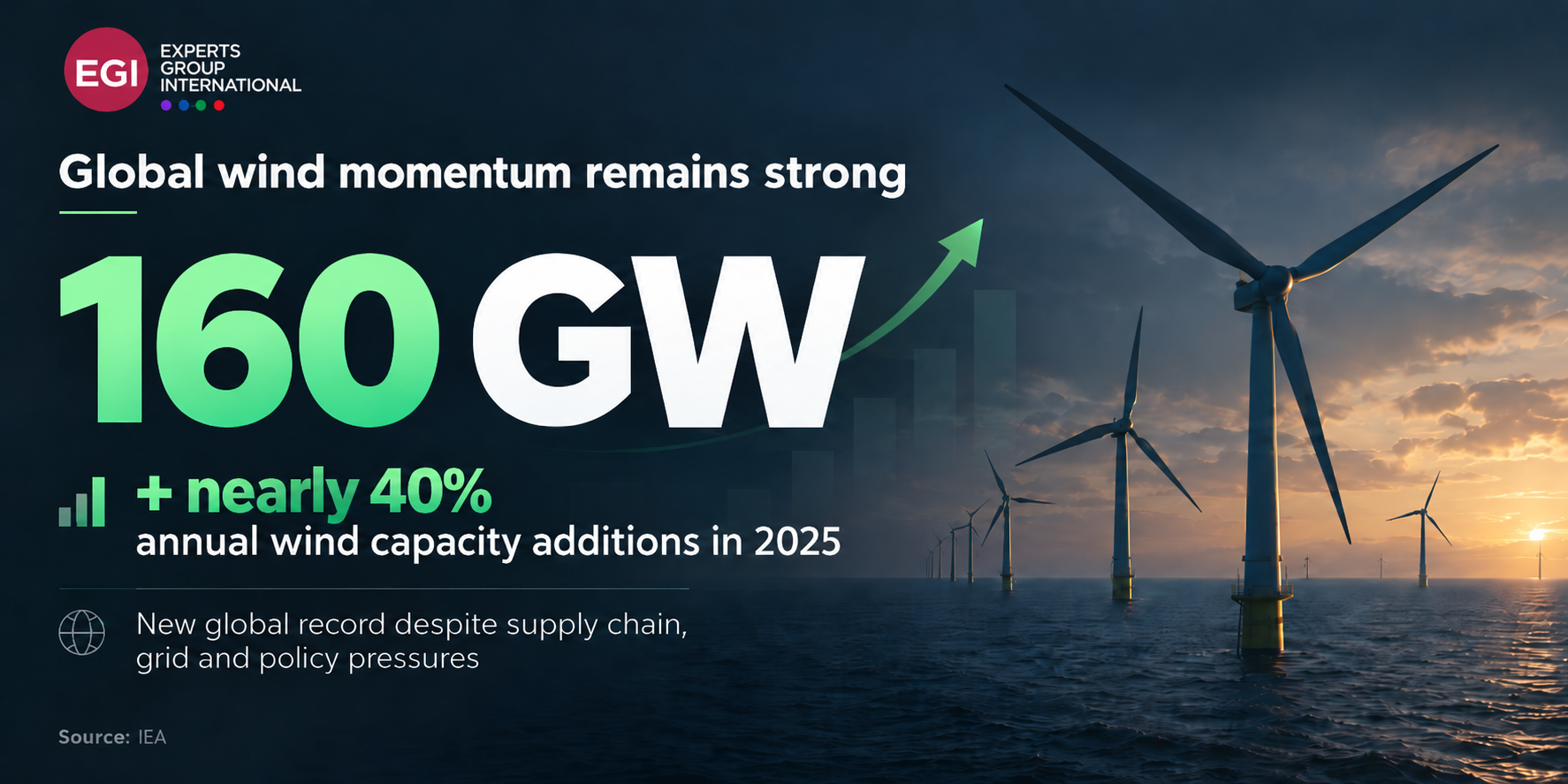
Global momentum is still strong. GWEC reports a record 165 GW of new wind capacity installed in 2025, up 40% on the previous year, taking global capacity to 1,299 GW. But much of that growth came from China, which added more than 120 GW on its own, and growth elsewhere is not moving without friction.
In Europe, the issue is particularly clear. WindEurope reported that Europe built 15 GW of new wind energy in 2024, but warned that not enough new wind farms are being built, pointing to permitting delays, delayed grid connections and slow electrification as key barriers to faster growth.
As demand increases and timelines tighten, this is also creating added pressure on hiring teams. Developers, utilities and suppliers need specialist talent faster, but speed can come at a cost. When hiring processes are rushed, there is a risk that quality drops, candidate alignment weakens and businesses make short-term hiring decisions that do not fully support long-term project delivery.
For hiring managers, the challenge is not simply filling roles quickly. It is finding people who can genuinely deliver in a market where technical skill, project experience and sector understanding are all critical. As competition for wind talent increases, businesses will need to balance pace with precision, making sure speed does not come at the expense of quality.
This shows that the next stage of wind power growth will not be defined by demand alone. It will depend on whether developers, utilities, suppliers and recruitment partners can bring together the right infrastructure, supply chains and specialist teams to deliver projects at the pace the market now requires.
Grid Capacity Is Becoming a Major Bottleneck
As wind power continues to scale, grid capacity is becoming one of the biggest barriers to delivery.
Building more turbines is only part of the challenge. For wind projects to create real impact, they need to be connected to the electricity grid quickly and efficiently. Without the right infrastructure in place, projects can face long connection delays, limited export capacity, and rising costs before they’re even operational.
This is already slowing progress across Europe. WindEurope has described grid access as the number one bottleneck to deploying wind energy at scale, with more than 500 GW of potential wind capacity currently waiting for grid connection assessment across markets including France, Germany, Italy, Spain, Poland, Romania, Ireland, Croatia and the UK. Clearing that queue means expanding and modernising Europe’s electricity grids fast enough to handle the growing volume of renewable generation.
For developers, utilities and suppliers, this creates a delivery challenge that goes well beyond generation. Grid connection specialists, electrical engineers, planning teams, project managers and commissioning professionals will all play a critical role in getting projects from approval to operation.
Because connection timelines are long, these are not roles that can wait until a project is approved. The companies that secure the right grid, engineering and project delivery talent early will be the ones best placed to keep projects moving in an increasingly competitive market.
For the wind sector, the message is clear: growth depends not just on building more capacity, but on building the infrastructure and teams needed to connect it.
Offshore and Onshore Wind Need Different Talent
The two markets are also very different in scale. Of the 165 GW installed globally in 2025, 155.3 GW was onshore and just 9.3 GW was offshore. New offshore awards also fell to 11.4 GW, around a fifth of the record 2024 level.
While both sit within the wider renewable energy sector, the skills, project environments and delivery challenges can be very different. Onshore wind often requires professionals who understand land agreements, local planning, permitting, grid connection, construction delivery and long-term site operations. These projects need people who can manage stakeholders, navigate regional requirements and keep developments moving through each stage of the project lifecycle.
Offshore wind brings a different level of complexity. Projects are typically larger, more capital-intensive and technically demanding, involving marine engineering, subsea infrastructure, port logistics, vessel coordination, offshore installation, HSE, commissioning and long-term asset management. The scale of these projects means businesses need highly specialised teams who can manage risk across multiple work streams and suppliers.
This creates a clear hiring challenge for developers, utilities and supply chain businesses. A candidate with strong renewable energy experience may not automatically be the right fit for every wind project. The technical demands, working environments and commercial pressures can vary significantly between offshore and onshore roles.
For hiring managers, this makes market understanding critical. It is not enough to hire people who have worked in wind or renewable energy more broadly. Businesses need people with the right project background, technical exposure and sector-specific experience to deliver in the environment they are being hired for.
As competition for wind talent increases, companies that understand these differences early will be better placed to build teams that are not only qualified on paper, but genuinely equipped to support delivery.

Supply Chain and Workforce Readiness Matter
As wind power grows, supply chain strength and workforce readiness are becoming just as important as project investment.
Wind projects rely on a wide network of manufacturers, suppliers, contractors and technical specialists. Turbines, blades, towers, cables, substations, vessels, grid equipment and maintenance infrastructure all need to be available at the right time for projects to move forward. When one part of the supply chain slows down, the impact can be felt across the full project timeline.
That is a concern across the industry. Even after a record 165 GW in 2025, GWEC says annual installations must double by 2030 to align with a net zero pathway, which puts more weight on the supply chains behind every project.
The workforce challenge is just as important. GWEC and the Global Wind Organisation’s Global Wind Workforce Outlook estimates that around 628,000 technicians will be needed between 2025 and 2030, with more than 40% expected to be new entrants to the industry. Workforce planning has to be treated as a core part of project development, alongside supply chain, infrastructure, permitting and grid planning.
For developers, utilities and suppliers, this means hiring cannot be left until the final stages of a project. Construction, installation, operations and maintenance all require skilled people who understand the technical demands of wind power and can keep projects moving safely and efficiently.
With more than four in ten of the technicians needed expected to be new entrants, the businesses that plan their workforce early, and work with partners who understand the market, will be best placed to keep projects on schedule.
Hydropower and Storage Are Becoming Wind’s Essential Partners
Renewable generation is scaling quickly, but wind and solar don’t always produce power when demand is highest. The market needs technologies that can store energy, balance supply and demand, and keep the grid stable when generation fluctuates.
That’s where hydropower and energy storage come in. Pumped-storage hydropower, battery storage and other flexibility solutions can absorb excess renewable generation, release power when demand rises, and ease pressure on the grid at peak times.
The IEA forecasts that annual pumped-storage hydropower additions will double to 16.5 GW by 2030, driven by the growing need for flexibility and long-duration storage as more variable renewable energy comes online.
Battery storage is scaling just as fast. Utility-scale battery additions reached a record 63 GW in 2024, bringing total installed capacity to 124 GW, according to the IEA.
And the scale of what’s still needed is striking. The IEA estimates that tripling global renewable capacity by 2030 would require energy storage to grow sixfold, to 1,500 GW.
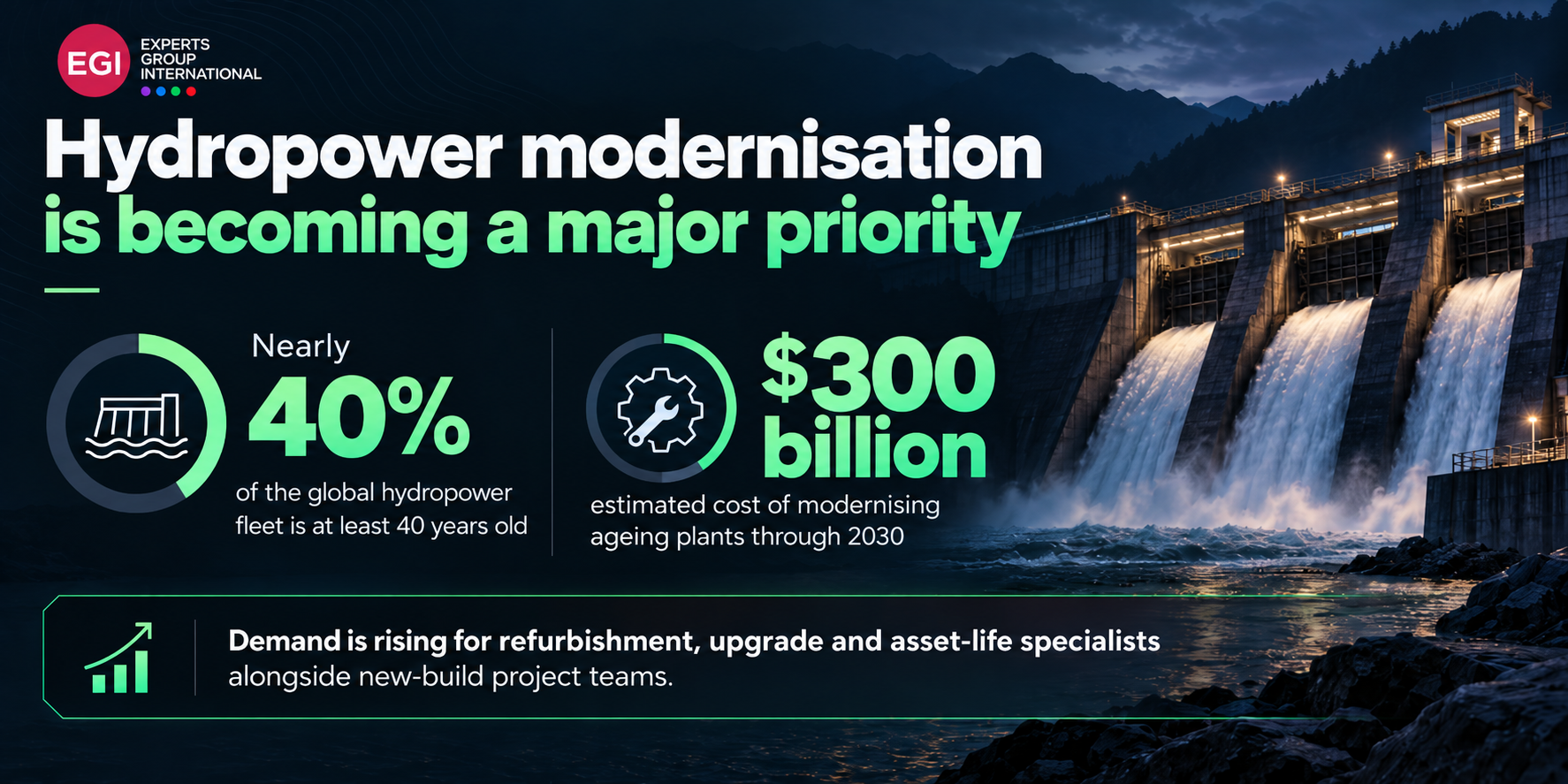
It isn’t only about new build, either. Nearly 40% of the global hydropower fleet is at least 40 years old, and IEA estimates put the cost of modernising ageing plants at around $300 billion through 2030. That creates demand for refurbishment, upgrade and asset-life specialists alongside new-build project teams.
For the wind sector, this matters because generation growth can’t be viewed in isolation. More wind capacity creates more need for grid flexibility, storage, balancing and system planning. Without them, projects risk curtailment, congestion and connection delays even after they’ve been built.
Increasingly, wind, storage and grid connection are developed as one integrated project rather than separate workstreams. That raises the value of people who can bridge those disciplines, and makes them some of the hardest hires in the market.
It also widens the hiring challenge. Businesses need more than wind specialists alone. They need professionals who understand grid integration, battery energy storage systems, pumped hydro, power markets, electrical engineering, asset optimisation and long-term system reliability.
We’re seeing this first-hand at EGI. Our CleanTech team has recently placed a Substation Project Manager, an Authorised Person, MCE Technicians on Vestas V90 turbines and a Co-Development Manager. It’s a mix of roles spanning grid, wind operations and project development.
As clean energy systems become more connected, the companies that can bring wind, storage, grid and hydropower expertise together will be best placed to deliver reliable renewable power at scale.
What This Means for CleanTech Hiring
As wind, storage, hydropower and grid infrastructure become more connected, CleanTech hiring is becoming more complex.
The challenge is no longer simply finding people with renewable energy experience. Businesses now need candidates who understand the specific technical, commercial and delivery pressures behind each project, whether that is grid connection, wind operations, battery storage, pumped hydro, project development or long-term asset optimisation.
For hiring teams, that means speed alone is not enough. As competition for specialist talent increases, there can be pressure to move quickly, but rushed hiring can weaken candidate quality, reduce alignment and lead to short-term fixes that fail to solve long-term delivery challenges. The companies that perform best will be those that can balance pace with precision, identifying people who are not only qualified on paper, but genuinely suited to the project environment they are entering.
For businesses, early workforce planning will become a major advantage. Companies that understand where skills are scarce, map talent before roles become urgent and build relationships with specialist candidates ahead of project demand will be better placed to protect timelines, reduce delivery risk and scale successfully.
Get in touch with our specialist Data Center recruitment team.
Submit your vacancy here for specialist recruitment support for scaling your data center project
Apply for our open roles here if you’re a data center professional seeking opportunities