How Will AI Impact Financial Services And What Does It Mean for Talent?

The Market Shift
Artificial intelligence is no longer a future concept for financial services. It is already starting to reshape how banks, insurers, fintechs, investment firms and payment providers operate, compete and serve customers.
From fraud detection and risk modelling to customer service, compliance, trading, underwriting and personal finance tools, AI has the potential to make financial services faster, more efficient and more personalised. The FCA’s 2026 Mills Review identified four major AI-driven shifts likely to affect retail financial services: firm operations, consumer journeys, competition and market power, and fraud and cyber risk.
How AI Will Transform Operational Efficiency
One of the most immediate impacts of AI in financial services will be operational efficiency.
Across banking, payments, insurance, lending and wealth management, firms are under pressure to deliver faster service, reduce manual workloads and improve customer experience without increasing operational risk. AI is already helping firms move closer to that goal by automating repetitive tasks, supporting customer service teams, improving access to internal knowledge and accelerating decision-making.
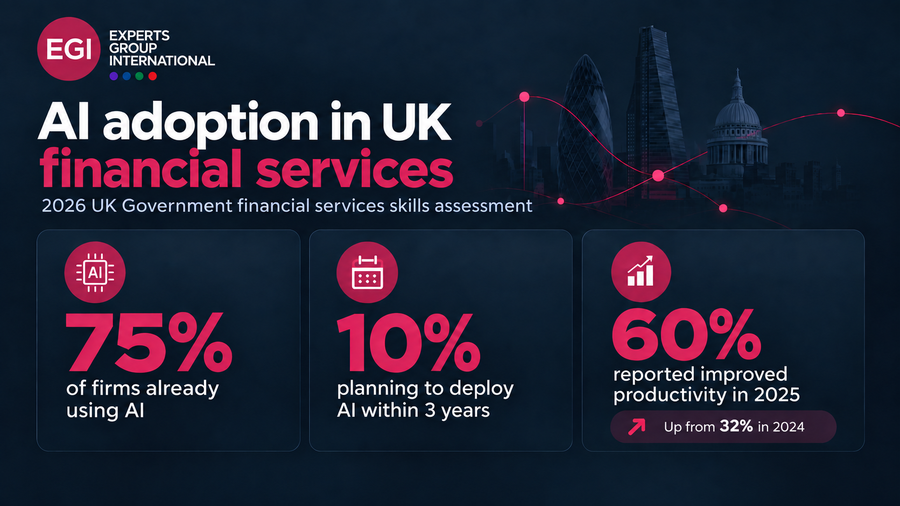
A 2026 UK Government financial services skills assessment reported that around 75% of firms surveyed by the Bank of England and FCA are already using AI, with a further 10% planning to deploy it within three years. The same assessment also found that nearly 60% of financial institutions reported improved productivity from AI in 2025, up from 32% in 2024.
Similar improvements are being seen in banking operations. BankUnited’s GenAI support tool can provide answers to customer questions in under 10 seconds, with a reported 95% accuracy rate and 24/7 support availability. In a sector where delays can affect customer trust, faster access to accurate information can make a significant difference to both customer satisfaction and internal productivity.
However, the biggest shift is not just faster customer replies. AI is changing how financial services teams work behind the scenes. Recent research from Cambridge Judge Business School found that the most common AI use cases in financial services are focused on internal operations, including process automation, data visualisation, software engineering and data management. This suggests that many firms are using AI first to improve execution, remove friction and make existing processes more efficient before moving into more advanced AI-led products.
For financial services businesses, the opportunity is clear: AI can help improve speed, accuracy and productivity across everyday operations. However, the firms that benefit most will not simply be those that adopt the latest tools. They will be the ones with the right people in place to implement AI properly, manage risk, train teams and turn technology into measurable business value.
Cybersecurity and fraud risks will increase
As financial services firms adopt AI, cyber and fraud risks are also becoming more sophisticated.
AI can be used positively to detect suspicious activity, monitor transactions, identify unusual patterns and strengthen fraud prevention. But the same technology can also be used by bad actors to create more convincing scams, automate cyberattacks, generate phishing messages, impersonate customers or employees, and produce deepfake audio or video.
This is becoming a major concern across the sector. The FCA’s 2026 review into AI in retail financial services identified the amplification of fraud and cyber risks as one of the four major AI-driven shifts likely to impact the market.
One of the clearest examples is deepfake fraud. Deloitte reported that 51.6% of executives expected deepfake attacks targeting financial and accounting data to increase over the following 12 months, while 25.9% said their organisation had already experienced at least one deepfake financial fraud incident in the previous year.
AI adoption cannot be separated from cybersecurity, fraud prevention and operational resilience. The firms that benefit most from AI will need to make sure they are not only using the technology to move faster, but also strengthening the teams, processes and controls needed to protect customers, data and trust.

Customer Experience Will Become More Personalised
As AI becomes more embedded across financial services, customer experience is likely to become faster, more predictive and more personalised.
For banks, wealth managers and payment providers, personalisation is no longer just about using a customer’s name in an email. AI can help firms understand customer behaviour, identify needs earlier, and deliver more relevant support, products and guidance at the right moment.
This shift is already being recognised by regulators. The FCA’s 2026 review into AI in retail financial services identified the evolution of consumer journeys as one of the four major AI-driven shifts likely to reshape the market. The review also found growing consumer appetite for AI-led personal finance tools, with FCA-commissioned research suggesting that around 1 in 5 UK adults would be likely to use AI that can act autonomously within pre-set financial goals.
For consumers, this could mean tailored banking apps, smarter budgeting tools, personalised investment support and more accurate customer service. McKinsey’s 2025 Global Banking Annual Review also highlighted how AI-powered insights, combined with mobile-first personalised experiences, are shaping the next stage of customer engagement.
However, personalisation comes with greater responsibility. Firms need to ensure AI-driven recommendations are fair, transparent and based on accurate data, while balancing innovation with strong governance, clear communication and human oversight.

The Biggest Challenge Will Be Finding Talent
While AI has the potential to transform financial services, the biggest challenge for many firms will not be the technology itself. It will be finding the people who can implement it, manage it and turn it into real business value.
AI adoption in financial services is no longer limited to technical teams. As AI becomes more embedded across operations, compliance, risk, fraud prevention, customer service and product development, firms will need people who understand both the technology and the commercial environment it is being used in.
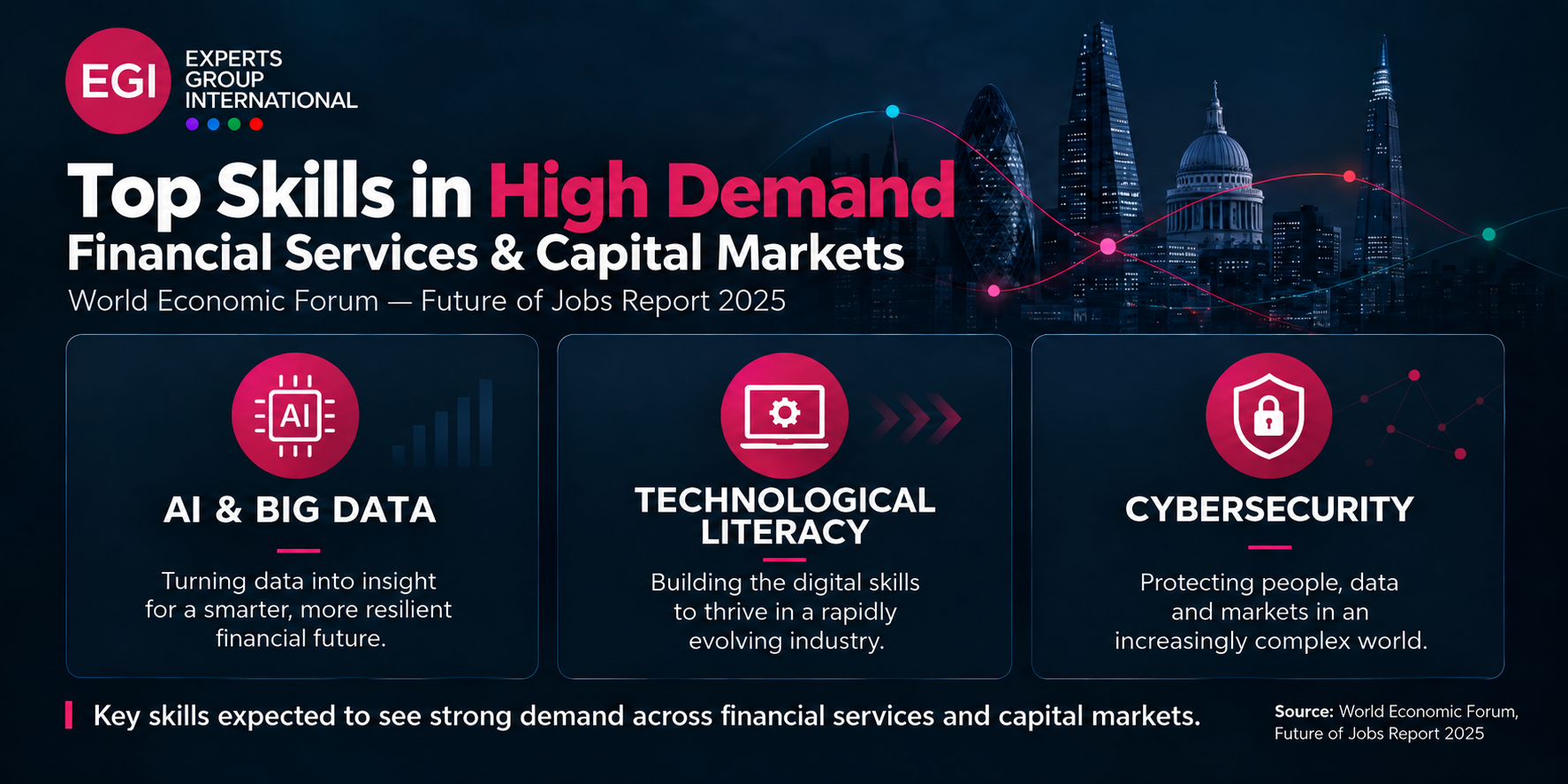
That shift is already being reflected in the skills market. The World Economic Forum’s 2025 Future of Jobs Report identified increased digitalisation as a key driver of transformation across financial services and capital markets. As a result, the report highlighted AI and big data, technological literacy and cybersecurity as skills expected to be in high demand across the sector. It also pointed to the creation of new roles such as Big Data Specialists, AI and Machine Learning Specialists, and Security Management Specialists.
This means the talent challenge will not only be about hiring more technical specialists. Financial services firms will also need leaders, compliance professionals, risk teams and product specialists who can work confidently with AI, understand its limitations and make decisions that balance innovation with regulation.
The firms that struggle will be those that treat AI as a purely technical investment. Without the right people behind it, even the most advanced tools can fail to deliver meaningful change. Poor implementation, weak governance or a lack of understanding across the business can limit the value of AI and increase operational, regulatory and reputational risk.
For financial services firms, this creates a clear competitive advantage for businesses that can build the right teams early. The organisations that benefit most from AI will be those with people who can move quickly, understand risk, work within regulation and apply AI in a way that improves performance without compromising trust.
What This Means for Financial Services Firms
AI is already changing financial services, but its impact will depend on how effectively businesses turn adoption into action.
The firms that succeed will be those that can use AI to improve efficiency, strengthen decision-making, personalise customer experience and manage risk, while still maintaining trust, compliance and human oversight.
For leaders across banking, insurance, fintech, payments and investment, the challenge is no longer just understanding what AI can do. It is building the teams, processes and leadership capability needed to make it work in practice.
As AI continues to reshape the sector, the businesses that move early on talent will be best placed to gain a competitive advantage. Whether that means hiring technical specialists, strengthening cyber and risk teams, or building leadership teams that understand both innovation and regulation, people will remain central to the future of financial services.
AI may be driving the change, but talent will decide how successfully that change is delivered.
Looking to Build the Teams Behind AI Transformation?
As AI adoption accelerates across financial services, securing the right talent will become increasingly important.
At EGI, we support businesses in identifying and engaging the specialist professionals needed to drive transformation, strengthen leadership and deliver long-term value across complex markets.
If you’re hiring across technology, financial services, AI, data or transformation, we’d love to hear from you.