Sound Strategy: How the Automotive Audio Sector Wins With the Right Product Teams
A Market in Motion
The in-car audio experience has shifted from a simple feature to a core differentiator for automotive brands. Consumers no longer just want a radio; they expect immersive, intelligent, and connected sound. For the companies delivering that experience, the race is on to build the product teams that can actually execute.
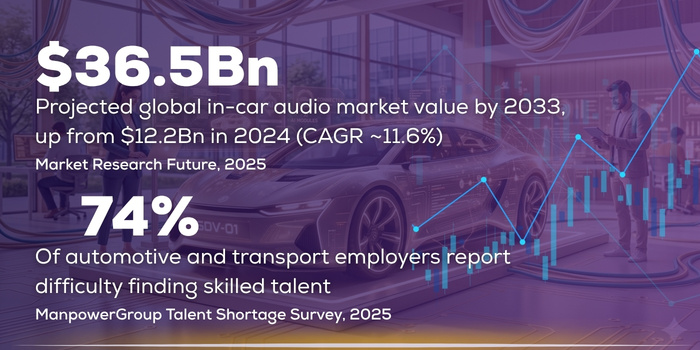
The global in-car audio system market was valued at approximately $12.2 billion in 2024 and is projected to reach $36.5 billion by 2033 (Source). This is a compound annual growth rate of over 11%. Behind every point of that growth curve is a product team making decisions about what to build, how to position it, and how to bring it to market (Source).
This is the context in which companies like HARMAN, Pioneer Electronics, Marelli, Forvia, and Qualcomm are competing. Each is navigating rapid technological change, shifting OEM expectations, and a talent market that simply cannot keep pace with demand. In this environment, the strength of your product team and your ability to build it is a genuine competitive advantage.
The Automotive Audio Sector: What’s Driving Change
Several forces are reshaping how automotive audio companies think about products, people, and strategy:
1. The Software-Defined Vehicle Revolution
Vehicles are increasingly software platforms first, hardware second. Audio systems are no longer isolated components; they are deeply integrated into digital cockpit architectures, connected to AI assistants, and updated over-the-air. This changes everything about what a product team needs to know and deliver.
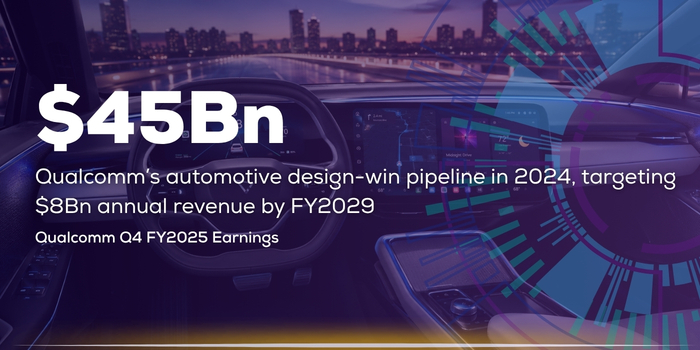
Qualcomm’s Snapdragon Digital Chassis platform is one of the clearest illustrations of this shift. Qualcomm’s automotive revenues surpassed the $1 billion quarterly milestone in Q4 FY2025, up 17% year-on-year, with a total design-win pipeline of $45 billion. The company is targeting $8 billion in automotive revenue by FY2029, a number that reflects the enormous commercial opportunity created as vehicles become rolling compute platforms.
2. Electric Vehicles Are Rewriting the Audio Brief
In a combustion-engined vehicle, engine noise masks many acoustic imperfections. In an EV, the cabin is near-silent, making premium audio both more important and more technically demanding. Automakers are now actively working with audio brands to create bespoke sound signatures, and active noise cancellation technology is becoming a standard rather than a premium feature.
Harman International, a Samsung subsidiary and arguably the most established name in automotive audio, won the award for “Supplier of the Year 2025” by General Motors. Under its new CEO, Christian Sobottka, formerly President of the Automotive Division, HARMAN is deliberately shifting towards a more product- and software-centric model (Source). Total group revenues reached $11 billion under outgoing CEO Michael Mauser, with a record $45 billion backlog in awarded automotive business.
3. Voice, AI, and the Connected Cockpit
Voice-recognised audio systems are forecast to hold a 62% market share by 2026, growing at an 11% CAGR. AI-powered sound enhancement, spatial audio, and personalised acoustic zones are moving from concept to production. The companies that can bring these features to market on time, at cost, with strong OEM partnerships are those with the right people in the right product roles.
4. A Market With Structural Talent Problems
The skills gap in automotive is well-documented and getting worse. The UK automotive sector currently has 20,000 unfilled roles across more than 200 job categories, making it the second most talent-deficient sector in the country (Source). Globally, the industry is projected to face a shortage of 2.3 million skilled workers by 2025, rising to 4.3 million by 2030. In some critical product and engineering roles, the demand-to-supply ratio has reached 10:1.

Product Teams: The Engine Behind Automotive Audio Strategy
In the automotive audio space, a product team is far more than a group managing a spec sheet. These teams sit at the intersection of technology, commercial strategy, OEM relationships, and consumer insight. They are responsible for translating market opportunity into a product roadmap, and that roadmap into revenue.
What a High-Performing Product Team Looks Like
Across the major players in this space, the characteristics of high-performing product teams are consistent:
- Clear product vision aligned with business strategy
- Teams that understand where the market is going, not just where it is
- Ability to connect product decisions to P&L outcomes
- Deep domain expertise
- Knowledge of automotive audio hardware, software, and OEM integration requirements
- Familiarity with the homologation process, platform lifecycles, and supplier dynamics
- Cross-functional leadership
- The ability to work with engineering, sales, marketing, and C-suite stakeholders simultaneously
- Strong communicators who can translate technical complexity into commercial language
- Commercial accountability
- Ownership of pricing strategy, go-to-market plans, and competitive positioning
- An ability to manage the tension between innovation investment and near-term revenue targets
- Commitment to core values
- Innovation, integrity, teamwork, excellence, inclusion, respect, and ingenuity are not just aspirational words for companies like HARMAN, Pioneer, and Forvia, they are the operational standards by which product decisions are made and talent is evaluated
Values-Led Hiring: Not a Nice-to-Have
The five companies at the forefront of automotive audio – HARMAN, Pioneer Electronics, Marelli, Forvia, and Qualcomm – each reflect the importance of product team strength in distinct but complementary ways.
HARMAN International
HARMAN’s strategic pivot under its new leadership is instructive. The shift from a hardware-led to a software- and product-centric business model is not something that happens by decree – it requires product managers, product marketers, and sales leaders who understand both the technology and the commercial levers. HARMAN’s core values emphasise innovation and excellence, and those values need to be embodied at the product team level to have any practical meaning.
With more than 50 million automobiles on the road equipped with HARMAN audio and connected car systems, the scale of product responsibility is enormous. Product decisions made today will be heard in vehicles for a decade.
Pioneer Electronics
Pioneer has evolved from a consumer audio brand into a significant player in automotive infotainment and navigation. The company’s ability to pivot its product offering in response to OEM demands, including voice-controlled tuning systems now featured in approximately 47% of its product lines, reflects a product team culture that values agility and ingenuity.
Marelli
Marelli’s talent-led growth story is particularly striking. In India alone, its Technical Centres expanded from 300 engineers in 2022 to nearly 1,000 by 2025, a threefold increase in three years. The company’s hiring philosophy prioritises capability and hands-on domain expertise over conventional credentials, a model that is increasingly recognised as essential in fast-moving technology environments.
Marelli’s stated mission is “to transform the future of mobility through working with customers and partners to create a safer, greener and better-connected world.” This requires product teams who can operate across the full value chain, from concept through commercialisation (Source).
Forvia
Forvia, formed from the merger of Faurecia and HELLA in 2022, now covers seating, interiors, lighting, electronics, clean mobility technology, and lifecycle solutions. Its digital and sustainable cockpit experience portfolio places it firmly in the automotive audio and in-cabin environment space. Forvia’s emphasis on sustainability and innovation is embedded in its hiring commitments, including specific programmes around gender diversity and early-career development.
Qualcomm
Qualcomm’s role in automotive audio is perhaps the most structurally significant. Its Snapdragon Digital Chassis platform is the compute and connectivity backbone on which many OEM audio and infotainment systems now run. Qualcomm’s automotive design-win pipeline reached $45 billion in 2024, with $15 billion in ADAS-specific opportunities alone. The product teams responsible for that pipeline are not just managing a chipset; they are managing platform relationships with virtually every major automaker globally (Source).
Qualcomm’s values around innovation and integrity are reflected in its product roadmap discipline: revenue targets of $4 billion by FY2026 and $8 billion by FY2029 are not aspirations; they are product commitments that require exceptional people to deliver.
Values-Led Hiring: Not a Nice-to-Have
Across HARMAN, Pioneer, Marelli, Forvia, and Qualcomm, a consistent set of values appears in public hiring commitments and strategic documents: innovation, integrity, excellence, inclusion, respect, teamwork, and ingenuity. These are not decorative. In automotive audio, they map directly to the operational behaviours that determine whether a product team succeeds or fails:
- Innovation: The willingness to build new things, not just iterate on existing ones. In a market moving this fast, product teams that lack a genuine innovation culture fall behind within product cycles.
- Integrity: Automotive products carry safety implications and long OEM relationships that depend on honest technical and commercial commitments. Product leaders who cut corners damage trust that takes years to rebuild.
- Excellence: OEMs hold suppliers to rigorous quality and delivery standards. Product teams that are not relentlessly focused on execution create downstream problems that reverberate through the supply chain.
- Inclusion and respect: diverse product teams make better decisions. This is not a platitude; it is supported by evidence across technology and manufacturing sectors. For audio products serving global vehicle lines, diverse perspectives improve outcomes.
- Teamwork and ingenuity: the complexity of modern automotive audio, spanning hardware, software, AI, connectivity, and OEM integration, cannot be navigated by individuals working in silos. Collaboration and creative problem-solving are the practical requirements of the job.
When hiring for product roles in this sector, values alignment is not secondary to technical skills it is the filter that determines whether a technically capable person will actually thrive and contribute in a complex, fast-moving, cross-functional environment.
The Critical Roles Driving Product Success
The following roles sit at the heart of product team performance in automotive audio. Each requires a specific blend of domain knowledge, commercial awareness, and leadership capability that makes them genuinely difficult to fill:
Product Management
Product Managers in automotive audio are responsible for defining what gets built and why. They manage roadmaps, prioritise features against OEM requirements, navigate platform lifecycles, and hold technical and commercial accountability simultaneously. The best product managers in this space combine software fluency with an understanding of the automotive supply chain and OEM qualification processes. A combination that is genuinely rare.
Product Marketing Management
Product Marketing Managers translate product capabilities into commercial propositions. In automotive audio, this means understanding the OEM customer, the end consumer, and the competitive landscape well enough to position products compellingly across all three. With the market moving toward AI audio, spatial sound, and software-defined systems, the ability to articulate differentiation in a technically credible way is becoming a premium skill.
Product Sales
Product Sales professionals in this sector sell technically complex, long-lead-time solutions to sophisticated OEM customers. The sales cycle can run years, and relationships are built on deep technical understanding as much as commercial acumen. Candidates need sector-specific networks and the confidence to engage with engineering, procurement, and executive stakeholders simultaneously.
Product Leadership
At the VP, Director, and Head of Product level, the requirement is to build and lead teams that can deliver on all of the above at scale. Strong leaders in this space combine strategic vision with operational discipline – they know how to run a global product function, how to manage OEM partnerships at an executive level, and how to create the culture in which their teams can do their best work.
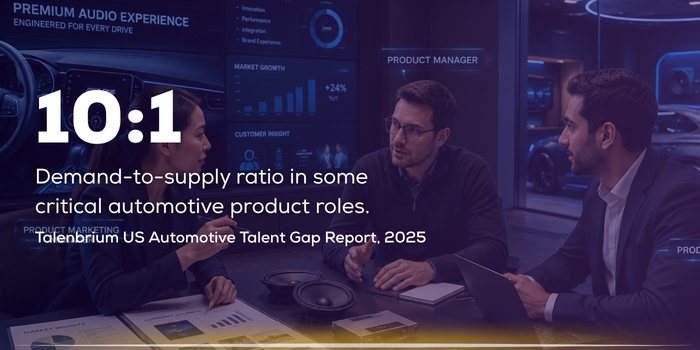
The shortage of candidates who genuinely combine all of these capabilities with automotive audio sector experience is one of the defining talent challenges of this moment. In some roles, demand-to-supply ratios have reached 10:1. This means that for every ten open positions, there is roughly one truly qualified candidate in the market (Source).
Why Specialist Recruitment Is the Answer
Given the combination of a fast-growing market, a specific set of in-demand roles, and a structurally constrained talent pool, generalist recruitment simply does not work at the level these companies need.
The 2025 ManpowerGroup Talent Shortage Survey found that 74% of automotive and transport employers are struggling to find skilled talent. Only 36% of hiring targets in the broader manufacturing sector were met in 2024. These numbers reflect a fundamental mismatch between what companies need and what a standard recruitment process can access (Source).
Specialist recruitment in automotive audio works differently. Here is why it matters across each of the critical role categories:
Access to Passive Talent
The most capable product managers, product marketing managers, and senior sales leaders in this sector are not applying to job boards. They are employed, often at direct competitors, and need to be identified and approached with a compelling reason to consider a move. This requires a recruiter who knows the sector, knows the candidates, and has the credibility to have that conversation.
Domain Credibility
Candidates at VP and Director level will not engage with a recruiter who cannot speak intelligently about the role, the company, or the competitive landscape. Specialist recruiters in automotive audio can articulate the difference between a cockpit domain controller role and a telematics platform role, and can assess whether a candidate’s experience is genuinely relevant, not just superficially similar.
Values and Culture Fit
Placing a highly capable person in the wrong cultural environment is a cost to both the candidate and the business. Specialist recruiters who work consistently within a sector develop an understanding of how different companies actually operate — beyond what the careers page says — and can match not just skills but working styles, leadership approaches, and cultural fit to the values that companies like HARMAN, Marelli, Forvia, Pioneer, and Qualcomm genuinely hold.
Speed and Precision
In a market where the demand-to-supply ratio for key roles can reach 10:1, the speed and precision of a hire matters commercially. A Product Manager role that sits open for six months is a product roadmap decision that does not get made, a customer relationship that does not get managed, and a revenue target that does not get met. Specialist recruiters reduce time-to-hire by bringing pre-qualified, relationship-mapped talent to clients faster than any internal team can replicate.
Long-Term Partnership
Building a product team is not a one-off exercise. As product lines evolve, as OEM relationships deepen, and as companies pivot to software-defined platforms, the talent requirement changes too. A specialist recruitment partner who understands the business and the market can support workforce planning at a strategic level, not just fill the next vacancy.

The Right People, in the Right Roles, at the Right Time
The automotive audio market is entering one of its most consequential periods of growth. The convergence of software-defined vehicles, AI-powered audio, EV adoption, and OEM partnership dynamics has created both enormous opportunity and genuine complexity for the companies at the centre of it.
HARMAN, Pioneer Electronics, Marelli, Forvia, and Qualcomm are all navigating this landscape with ambition and scale. Their ability to execute on that ambition depends, more than any other factor, on the quality of the product teams they build. And building those teams with the right values, domain expertise, and commercial capability requires a recruitment approach that matches the sophistication of the challenge.
Specialist recruitment is not a premium on top of standard hiring. In a sector this specialised, with talent this scarce, it is simply the most reliable way to get the right person into the room.
If you’re building a product team in automotive audio or looking for your next move within one, we’d welcome the conversation.

Key Hires Defining Data Center Success in 2026
The Talent Behind the Trillion Dollar Buildout
The data center industry is in the midst of the most aggressive infrastructure expansion in modern history. Fuelled by the explosion of AI workloads, cloud demand, and the race for sovereign compute capability, the world’s biggest technology companies are pouring capital into facilities at a pace and scale that is genuinely unprecedented.
But behind every megawatt of capacity, every GPU cluster, and every cooling system lies a workforce – and right now, that workforce is critically undersupplied. For organisations executing these projects, talent is not a secondary concern. It is the primary constraint on delivery.
In this article, we explore the scale of the global data center boom, what makes AI data centers fundamentally different from their predecessors, the critical roles driving project success in 2026, and why partnering with specialist recruitment consultants is the single most effective lever available to hiring teams under pressure.
The Scale of the Global Data Centre Buildout
To understand the urgency of the talent challenge, you first need to understand the scale of what is being built.
The Numbers Are Staggering
- Global data centre capex in 2026: Exceeds $1 trillion (source)
- Hyperscaler spend in 2026: $700 billion from six major players alone – nearly six times their 2022 spend (source)
- 2025 hyperscaler total: Microsoft, Amazon, Alphabet, Oracle, Meta, and CoreWeave spent nearly $400 billion in 2025, with $200 billion more forecast over the following two years (source)
- Data center spending growth in 2026: Up 55.8% year-on-year, expected to surpass $788 billion (source)
- Total investment by 2030: Up to $3 trillion projected, underpinning a global sector growing at 14% CAGR (source)
- Operational hyperscale facilities = 1,297 worldwide as of late 2025 – nearly triple the number from 2018 (source)
The Major Players and Their Footprints
The six dominant hyperscalers are driving the vast majority of this investment:
- Microsoft: Deploying capital across Europe, Asia-Pacific and the Americas, with data center investments tied directly to Azure and OpenAI infrastructure commitments
- Amazon Web Services (AWS): Opening new regions in Saudi Arabia ($5.3 billion), Europe and Asia, with capex trending toward $100 billion annually
- Alphabet (Google): Expanding into Sweden, South Africa, Mexico, Kuwait, Malaysia, Thailand, and Turkey ($2 billion committed), among others
- Meta: Forecast capital expenditure of $115–135 billion in 2026 alone, driven by Llama AI model development; CEO Mark Zuckerberg has called 2026 ‘a year where the AI wave accelerates even further’
- Oracle: Redirecting substantial resources from restructuring into cloud infrastructure, with aggressive multi-region capacity expansion
- CoreWeave: The fastest-growing AI cloud provider, building GPU-dense facilities at scale to serve model developers and enterprises
“The global hyperscale data center pipeline totals 770 future facilities, with total hyperscale capacity expected to double in just over 12 quarters.” – Data Center Knowledge, March 2026 (source)

AI Data Centers vs. Traditional Data Centers: A Fundamental Difference
Not all data centers are created equal – and the distinction between AI-optimised facilities and traditional general-purpose data centers is not merely technical. It is architectural, operational, and organisational.
Traditional Data Centers
Traditional facilities are built for diverse, mixed workloads: web hosting, enterprise applications, databases, email, and standard cloud services. Their characteristics include:
- CPU-centric compute architecture, well-suited to sequential processing tasks
- Rack power densities typically ranging from 5 to 30 kW
- Network speeds generally topping out at 10–20 Gbps
- Air cooling as the dominant thermal management approach
- Bursty, variable workloads that allow for some power balancing across the facility
AI Data Centers
AI data centers represent a fundamentally different engineering and operational challenge. Designed to train large language models, run inference engines, and process vast datasets in parallel, they demand infrastructure that bears little resemblance to what came before:
- GPU and HPU-centric compute – GPUs can run thousands of simultaneous calculations, making them essential for AI training and inference; a single NVIDIA H100 GPU draws 700W of power
- AI-enabled racks can demand up to six times more power than traditional counterparts, with densities commonly exceeding 30–50 kW per rack and projections from Google suggesting racks could surpass 500 kW within five years
- Network speeds must reach 100 Gbps or higher to move data between GPU clusters at the rate AI models require
- Liquid cooling is no longer optional – it is essential, as conventional air cooling cannot manage the thermal output of high-density AI workloads
- Training clusters run at sustained, near-maximum load for extended periods – these are not bursty workloads; they are constant, intensive computation
“AI data centers must be packed full of GPUs that are significantly more energy intensive since they work at much greater voltages. With AI-enabled racks demanding up to six times more power than their traditional counterparts, data center developers are increasingly prioritising locations where renewable energy is abundant and climates are naturally cooler.” – Data Center Dynamics, May 2026 (source)

Energy Demand: The Scale of Difference
- Global data center electricity use in 2025: 485 TWh – up 17% in a single year (source)
- Projected demand by 2030: Approximately 950 TWh – roughly 3% of global electricity demand (source)
- AI-driven consumption forecast: Electricity use from AI-specific facilities alone is forecast to quadruple over the same five-year period
This energy reality has direct consequences for infrastructure design – and for the type of talent required to build, commission, and operate these sites.
The Critical Hires: Roles That Define Project Success
With capex in the hundreds of billions and construction timelines under constant pressure, the quality and availability of talent in the following roles directly determines whether a data center project is delivered on time, within budget, and to specification.
1. Liquid Cooling: Sales and Hiring Managers
Liquid cooling has moved from a specialist niche to a mainstream requirement. The market tells the story clearly:
- Global liquid cooling market size in 2026: $6.77–$8.2 billion (source)
- Projected market size by 2031–2033: $18.79 billion to $29.5 billion (source)
- Market CAGR: 20–31% depending on the segment (Grand View Research / Mordor Intelligence, 2026)
- UK liquid cooling growth: Expected CAGR of over 19% between 2026 and 2035, driven by London’s position as Europe’s largest data center market
Direct-to-chip and two-phase immersion cooling are now central to hyperscale AI deployments. Sales professionals who understand the technical landscape – thermal physics, coolant chemistry, rack integration – are in exceptional demand from OEMs, system integrators, and facility operators alike. Hiring managers within cooling divisions are equally critical, tasked with rapidly scaling teams capable of designing, installing, and maintaining solutions that did not exist at commercial scale five years ago.
2. Network Engineers
The networking requirements of an AI data center are categorically different from those of traditional facilities. AI workloads demand:
- High-speed fabric architectures, including EVPN and Clos topologies at 400G
- Ultra-low latency interconnects between GPU clusters – delays of microseconds can degrade model training performance
- Data transfer speeds of 100 Gbps or higher to feed AI models at the rate they require
- Expertise in high-performance networking solutions that are still evolving rapidly at the hardware and protocol level
Network engineers comfortable with modern AI fabric design are among the most sought-after professionals in the sector. Traditional networking experience alone is insufficient – candidates must understand the specific demands of tightly coupled, synchronised AI workloads.
3. Controls Engineers
Controls engineers are the backbone of mission-critical operations. In a data center environment – particularly AI facilities running at extreme power densities – they are responsible for the building management systems (BMS) and electrical control infrastructure that keeps everything functioning within safe parameters.
Their remit includes:
- BMS programming and integration for power distribution and cooling systems
- SCADA system design and maintenance
- Automation of thermal management under variable load conditions
- Commissioning of new systems and validation of operational readiness
The data center workforce shortage report from Data Center Geeks (source) identifies controls technicians as one of the hardest roles to fill in the entire construction and operations pipeline, second only to journeyman electricians.
4. AI Capabilities – Infrastructure and Integration
As AI moves from training cluster to operational deployment, a new class of professionals has emerged: those who understand both the infrastructure layer and the AI workload running on top of it. These individuals bridge the gap between data center operations and the machine learning teams they serve.
Key competencies include:
- Understanding of model training and inference workload patterns and their infrastructure implications
- Experience with AI accelerator hardware – NVIDIA H100/B200 series, AMD Instinct, and emerging custom silicon
- Familiarity with MLOps pipelines and the compute resources they demand
- Ability to translate AI capacity requirements into infrastructure procurement and design decisions
Professionals with this hybrid profile are extraordinarily rare and command significant compensation premiums.
5. GPU & HPU Specialists
Graphics Processing Units remain the dominant compute engine for AI workloads, while High-Performance Units (HPUs) – including custom AI accelerators from companies such as Cerebras, Groq, and SambaNova – are gaining ground for specific inference applications.
Specialists in this area include:
- Hardware operations professionals who deploy, maintain, and replace GPU and HPU infrastructure at scale
- Procurement and supply chain specialists navigating an extremely constrained GPU market
- Engineers who understand the thermal and power characteristics of dense accelerator clusters
- Solutions architects capable of designing GPU cluster topologies for specific model training requirements
With each NVIDIA H100 drawing 700W and racks of eight drawing 5.6 kW before accounting for cooling overhead, the safe and efficient deployment of GPU infrastructure requires deep specialist knowledge.
6. Hardware (HW) Operations Leads
Hardware Operations Leads sit at the intersection of physical infrastructure and uptime accountability. In hyperscale environments, they are responsible for:
- Overseeing the physical deployment and lifecycle management of thousands of servers, storage units, and networking devices
- Managing RMA (Return Merchandise Authorisation) processes and hardware refresh cycles
- Coordinating with data center facilities teams on power draw, cooling capacity, and physical space allocatioN
- Ensuring operational continuity during hardware transitions and upgrades
- Leading and developing teams of hardware technicians operating on shift patterns across 24/7 environments
These are senior, experienced hires – and the combination of hyperscale operational experience, leadership capability, and technical depth makes them exceptionally hard to source through general recruitment channels.

The Talent Gap: A Structural Crisis
The demand for skilled data center professionals has comprehensively outpaced supply – and the gap is widening.
- Operators struggling to find qualified candidates: 53% – up from 38% in 2018 (Uptime Institute Global Data Center Survey, 2024)
- Average time to fill mission-critical roles: 60+ days (source)
- Construction labour cost inflation: 8-12% year-on-year in primary North American markets (Turner & Townsend, 2024)
- Biggest bottleneck in 2026: The data center workforce shortage – ranked ahead of power availability and land supply (source)
The talent shortage is structural, not cyclical. Several forces are converging simultaneously:
- The hyperscaler capex cycle is still accelerating – announcements from late 2025 and early 2026 suggest two to three further years of growth before any plateau.
- Many experienced electrical, mechanical, and controls professionals are nearing retirement age
- Secondary markets (Columbus, Des Moines, Reno, Indiana) are absorbing multi-billion dollar hyperscaler announcements and must import talent, driving up per diem and relocation costs
- AI data centers require skill profiles that simply did not exist five years ago – there is no established talent pipeline for liquid cooling integration specialists or GPU operations leads at scale
- Competition from the semiconductor and energy sectors for the same engineering talent pool intensifies the pressure
“Hiring in today’s market is hard, particularly for mission-critical environments. Generalist recruiters usually lack the technical context needed to properly vet candidates, which leads to long shortlists, mismatched hires, and wasted time for already stretched teams.” – Alpha Apex Group, January 2026 (source)
Why Specialist Recruitment Is the Decisive Advantage
In an environment where every unfilled role means increased strain on existing staff, missed commissioning windows, and delayed capacity coming online, the approach taken to talent acquisition is not a back-office HR matter. It is a strategic project execution decision.
Generalist recruitment – whether through internal HR teams or broad-market agencies – consistently underperforms in mission-critical data center hiring. The reasons are structural:
- Generalist recruiters cannot evaluate technical CVs accurately – a controls engineer with BMS experience in commercial property is not the same as one with hyperscale commissioning credentials
- They do not have pre-qualified networks in niche disciplines like liquid cooling sales or GPU operations
- They lack the market intelligence to advise on compensation benchmarks in a market where pay bands are shifting 8–12% per year
- Long shortlists of mismatched candidates waste time that project teams simply do not have
What Specialist Recruitment Consultants Deliver
Working with a specialist recruitment consultancy that operates specifically within data center, critical infrastructure, and technology disciplines changes the equation:
- Access to passive candidates: The best professionals in liquid cooling, AI infrastructure, and hardware operations are rarely active job seekers. Specialist consultants maintain relationships with these individuals over years, not weeks
- Technical vetting that holds: A consultant who understands what a Controls Engineer does in a Tier III facility can screen accurately at the first stage, eliminating weeks of interviewing unsuitable candidates
- Market intelligence: Real-time visibility into competitor compensation, emerging role requirements, and talent availability by geography allows hiring managers to make faster, better-informed decisions
- Speed to shortlist: Specialist consultants can typically present a credible, vetted shortlist in days rather than weeks, a critical advantage when a commissioning milestone is at risk
- Risk reduction: A bad hire at the Hardware Operations Lead level can delay a facility going live, impact uptime SLAs, and cost multiples of the recruiter’s fee in remediation. Specialist consultants reduce that risk materially
- Project lifecycle coverage: From design-phase engineers through to operations and maintenance teams post-handover, a specialist partner can support the full talent arc of a multi-year data center programme
Talent Is the Infrastructure
The data is unambiguous. Global investment in data center infrastructure is reaching unprecedented levels. AI is creating a category of facility that demands specialist design, specialist equipment, and above all, specialist people. The workforce shortage is real, structural, and not going away.
The organisations that execute most effectively in this environment will not simply be those with the largest capex budgets. They will be those who treat talent acquisition with the same rigour they apply to site selection, power procurement, and engineering design.
The key hires of 2026 – liquid cooling specialists, network engineers, controls engineers, AI infrastructure professionals, GPU and HPU operations leads, and hardware operations leaders – are the human infrastructure on which every physical data center project depends. Finding them, assessing them accurately, and securing them in a competitive market requires specialist knowledge that generalist approaches cannot reliably provide.
Working with a specialist recruitment consultancy that lives and breathes this sector is not an overhead. It is one of the most cost-effective project risk mitigation strategies available to any data center programme today.
Get in touch with our specialist Data Center recruitment team.
- Submit your vacancy here for specialist recruitment support for scaling your data center project
- Apply for our open roles here if you’re a data center professional seeking opportunities


How Top Texas Contractors Hire Management for Major Infrastructure Projects
Texas is in the middle of a $200 billion infrastructure moment – and the contractors winning the best projects aren’t finding their superintendents on job boards.
This region in particular is facing an influx of stacked programs. And 2026 is as much a staffing and sequencing challenge as it is a construction opportunity.
The scale of what is being built across the state right now is without precedent. The workforce challenge sitting underneath it is just as significant. And the contractors who understand both and can also act on them now are the ones who will deliver.
The Texas opportunity
The heavy construction and utilities industries’ numbers define the moment.
Texas has committed a record $148 billion transportation investment program extending through 2034, which is one of the largest Unified Transportation Programs the state has ever adopted.
That programme alone is just the starting point. More than $200 billion in planned and ongoing transportation and utility infrastructure improvements are now in motion across the state, driven by a combination of local, state, and previously allocated federal infrastructure funding (source).
Texas voters approved a further $20 billion long-term water plan in 2025, and water infrastructure alone represents a $154 billion long-term investment requirement, with excavation and underground utility scopes representing 20 to 50% of major infrastructure project value and creating an $11 to $14 billion addressable market in North Texas alone through the mid-2030s. (source)
Alongside that, a $1.6 billion natural gas liquids pipeline is underway connecting the Permian Basin to Mont Belvieu, data centre construction in the Dallas-Fort Worth corridor continues at pace, and semiconductor facilities from the likes of Samsung are creating some of the most technically demanding construction environments in the country. (source)
Texas is on track to lead the nation in construction spending
with $50.33 billion committed to projects in 2025 alone, and that momentum is carrying directly into 2026 and beyond. The opportunity is real, significant, and sustained. But delivering on it requires something that cannot be funded by a transportation bill or a water plan.
It requires the right people in the right roles before the project demands them.

The Texas Construction Talent Landscape
Here is where the picture becomes more complex and more urgent.
The U.S. construction industry must attract 349,000 net new workers in 2026 just to meet current demand. That figure is projected to rise to 456,000 in 2027 as spending growth accelerates. Texas is one of the most acutely impacted states. The labour shortage is not a looming risk here. It is a present and escalating challenge. (source)
45% of construction firms nationally report delaying projects due to labour shortages. Nearly one in five firms report turning down work due to labour limitations altogether. The problem is also not evenly distributed across roles. The most experienced, most impactful, and most difficult to replace professionals are:
- Project Superintendents
- General Superintendents
- Project Managers
- Foremen
These construction professionals are in short supply and high demand.
Senior superintendents and project managers turn over at roughly a quarter of the rate of their non-senior counterparts. Senior-level supers and PMs simply do not move around at nearly the same rate.
In Houston, construction superintendents earn between $90,000 and $130,000, with top earners running large heavy civil or infrastructure projects reaching $150,000+ and above. The ongoing competition for qualified labour means experienced superintendents have more negotiating power. Candidates receive multiple offers within days of entering the market, and a constant inbound call flow from competitive firms and projects that need their expertise.
The workforce conversation in Texas construction needs to move beyond bodies. The contractors under the most pressure are not always in the tightest labour markets. Many suffer with a thin leadership infrastructure, unclear succession plans, and too few people ready for the next level. This causes crews to lose time when work is poorly sequenced. Young workers leave when no one develops them. Superintendents burn out when every field problem lands on the same few people. Project managers lose control when RFIs, procurement, owner decisions, subcontractor coordination, and manpower planning are handled too late.
The implication for hiring managers is direct. Replacing a superintendent or project manager costs between 50 and 200% of their annual salary, with senior field leadership at the higher end of that range. The harder the role, the longer it takes to source, and longer still to bring up to full productivity on a live project (source).

What the best contractors do differently
The contractors consistently delivering on major Texas construction and utilities programmes on time, within budget, and with the right field leadership in place, share a common approach to workforce planning. They do not treat hiring as a reactive function. They treat it as their competitive advantage.
Here is what that looks like in practice:
- They build their leadership pipeline before the award window hits: The contractors winning this cycle are monitoring project letting and programme movement and building relationships with experienced field leaders such as Project Superintendents, General Superintendents, Foremen, and Project Managers before a specific vacancy exists. By the time a project is awarded, their key hires are already in conversation, not in a job posting.
- They align compensation with current market conditions, not last year’s benchmarks: In a market where experienced Texas construction superintendents command $100,000 to $150,000+, depending on project type and complexity, firms that rely on stale pay bands lose. The candidates they need will already have multiple offers on the table. Compensation benchmarked to 2024 is not a strategy in 2026.
- They recognise that the best field leaders are not on job boards: Senior superintendents and project managers in Texas’s heavy construction and utilities don’t move around lightly. They are constantly mid-project, mid-cycle, and accessible only through trusted professional networks, not through LinkedIn job posts or Indeed listings. Reaching them requires a recruiter who is already in those conversations and who has the credibility to have them. Oftentimes, private WhatsApp groups and good old-fashioned candidate relationship maintenance are the best way to successfully hire the best construction professionals.
- They work with specialist recruitment partners from the start – not as a last resort: The most effective hiring managers in Texas construction engage a specialist recruiter at the planning stage – not the panic stage. That distinction matters enormously. An experienced construction recruitment partner who understands heavy civil, utilities, and infrastructure projects can compress your time to shortlist significantly, present candidates who are pre-vetted for project type and cultural fit, and navigate the negotiation process in a market where candidates have leverage. Good recruiters within these private networks will have project foresight across the regions and will know who is available across the planned time for the project at hand. Knowledge of these candidates 3,6 & 12 month availability windows is key to landing the best talent.
- They define the mandate before they define the title: A General Superintendent on a major water infrastructure programme in North Texas is a fundamentally different hire from a General Superintendent on a highway interchange build or a utility corridor project. The best hiring managers define what success looks like for the specific programme, environment, and team – before they brief a recruiter or write a job description. Clarity on scope and mandate will ensure that your specialist recruiter can find the most qualified candidate for the project and avoid attrition before milestones are complete.
Where Experts Group International makes the difference
We have successfully placed numerous key personnel in the past year, including Project Superintendents, General Superintendents, Project Managers, and Foremen for heavy construction, utility, and infrastructure programmes across Texas and the USA.
We understand the project environments, the compensation landscape, and the field leadership profiles that deliver results on complex, high-value programmes. And we maintain the relationships with experienced, passive candidates who are not browsing job boards but who would make the right move for the right opportunity.
If you are a hiring manager planning your workforce for a major Texas construction or utilities programme in 2026, do not wait until the project demands it.
The window to secure proven field leadership in this market is narrower than it has ever been.
For hiring construction specialists, connect with our North America team
🔸Ieuan Davies (Director & Head of Austin)
🔸Robyn Britton (Delivery Consultant)
🔸Jack Simpson (Senior Sales Consultant)
🔸Catalina Aguilar (Delivery Consultant)
If you are scaling a project team across heavy construction, utilities, or infrastructure in Texas or other USA territories, our team is ready to move with you. We bring sector-specific knowledge, established candidate networks, and a process built around your project timeline – not a generic recruitment cycle.


Hiring the Right Leadership – Why C-suite, Head of, and Director are Not Interchangeable Titles
Businesses make hiring mistakes at every level. But the most consequential – and the most costly – happen at the top.
In 2026, the demand for senior and executive leadership across renewable energy, manufacturing, financial services, construction, and industrial sectors has never been higher. Neither has the complexity of getting those hires right.
One of the most persistent and most expensive mistakes organisations make when building their leadership teams is treating C-suite, Head of, and Director-level roles as variations of the same thing. They are not. Understanding the distinction is not just an exercise in organisational design. It is the difference between a hire that transforms a business and one that quietly costs it.
The hierarchy in practice – what each level actually means
Before exploring what makes each leadership tier distinct, it is worth establishing what separates them in the first place.
C-Suite
C-suite executives hold final decision-making power across the organisation – they set enterprise-wide strategy and report directly to the Board of Directors (source). The scope is total. The accountability is ultimate. A Chief Financial Officer, Chief Procurement Officer, or Chief Human Resources Officer is not managing a function. They are shaping the direction of the entire business from within it.
Directors
Director-level roles typically lead multiple teams or a significant function, often managing managers, with responsibilities spanning functional strategy, resource allocation, and cross-team coordination, usually reporting to a VP or C-suite executive.
Heads of
Head of roles sit in a nuanced space between the two. They carry functional ownership and leadership responsibility – often the most senior individual within a given discipline at a regional or national level – but without the enterprise-wide mandate of the C-suite. They are operationally deep and strategically connected, but their authority is bounded by function and geography rather than the organisation as a whole.
Research from LinkedIn indicates that leadership title confusion is widespread – 72% of professionals cannot accurately describe the differences between common executive titles. For hiring managers, that confusion translates directly into misaligned briefs, wrong shortlists, and costly mis-hires.
What the job descriptions reveal – three tiers, one common thread
Across six live senior and executive mandates that Experts Group International is currently working – spanning finance, legal, sales, procurement, and HR across renewable energy, manufacturing, financial services, and construction – the distinctions between these three tiers become immediately visible.
But so does the thread that connects all of them.

1. C-suite – the enterprise architects
At the highest level, the mandate is always the same: define the strategy, own the outcomes, and report to the board.
1A: The Chief Financial Officer is responsible not just for financial reporting and compliance, but for translating financial strategy into competitive advantage. Creating and presenting tax strategy to the CEO. Overseeing cash flow, audits, working capital, and bank relationships. The CFO is not a reporter of financial performance. They are an architect of it.
1B: The Chief Procurement Officer operating across a multi-country renewable energy portfolio carries an even broader remit – defining procurement strategy across the full project lifecycle, from development and EPC through to construction and operations. Negotiating major OEM and EPC agreements at GW scale. Building and managing executive relationships with Tier-1 suppliers. Anticipating supply constraints across global equipment markets and embedding ESG standards into every sourcing decision.
In 2026, executive leadership is defined less by where someone has been and more by how they think, decide, and adapt (source).
Boards are asking sharper questions: How does this leader perform when data is incomplete or conflicting? Can they make decisive calls without waiting for perfect conditions? Can they maintain momentum without burning out their teams?
Digital transformation, sustainability, and workforce expectations have reshaped senior leadership structures. Therefore, C-suite executives are increasingly managing multiple strategic domains, often combining operational oversight with specialised expertise (source).
The profile required at this level is not simply technical excellence. It is the ability to operate across the entire organisation commercially, legally, operationally, and strategically simultaneously (source).
2. Head of – the functional leaders
One level below the C-suite sits a tier of leadership that is frequently underestimated by hiring managers – and frequently over-sought by candidates who are not yet ready for it.
2A: The Head of Legal, for example, in a fast-growing international renewable energy business, is not a senior lawyer. They are the primary legal interface between a growing national operation and its international headquarters. They manage corporate governance, M&A transactions, project financing, EPC contracts, Power Purchase Agreements, and land lease negotiations – often in two languages, across multiple jurisdictions, with litigation oversight and external counsel coordination running in parallel.
2B: The Head of Sales is often carrying full commercial responsibility for a €25 million+ portfolio across a multinational region such as DACH, or the Benelux. They are not a sales manager with a bigger team. They are a commercially strategic leader defining pricing strategy, margin management, and regional commercial policy – while managing key customer relationships across industries such as automotive, aerospace, tooling, energy, or industrial engineering sectors simultaneously.
Today’s boards are placing less emphasis on traditional markers of readiness and more on leaders who can navigate complexity, integrate functions, and deliver impact across the enterprise. At the Head of level, that same expectation applies – but within the boundaries of a function or region rather than the enterprise as a whole (source).
The most effective ‘Head of’ hires combine deep domain expertise with genuine leadership capability. They have the ability to build and develop a team, manage upward to C-suite stakeholders, and influence across functions they do not directly control.
3. Director – the bridge between strategy and execution
The Director tier is where strategic intent meets operational reality. It is arguably the most demanding leadership level to hire for precisely because it requires both in equal measure.
3A: The Human Resources Director for a growing construction business in the Middle East is expected to develop and implement a comprehensive talent acquisition strategy aligned with business growth – while simultaneously managing high-volume recruitment across technical, engineering, and project management functions, designing competitive compensation frameworks aligned with UAE market benchmarks, ensuring compliance with UAE Labour Law and WPS requirements, and providing strategic counsel to executive leadership on all people-related matters.
3B: Director of Corporate FP&A – a role within a large, multi-country financial services organisation is expected to lead enterprise-wide cost optimisation and governance frameworks, produce Board and executive packs with clear insights and actionable recommendations, own annual budgets, rolling forecasts, and long-range planning cycles, and build and lead a geographically dispersed FP&A team.
Future leadership requires EQ and adaptability more than pure domain experience. Organisations are looking beyond operational efficiency in today’s market; they’re seeking executives who can lead through volatility, anticipate shifts, motivate teams through uncertainty, and steer change with clarity and calm (source).
At the Director level, that combination is non-negotiable. The best Director hires in 2026 are those who have already demonstrated they can operate strategically, and who have the credibility, communication capability, and commercial instinct to do so at the next level.
The common thread across all three tiers
Looking carefully at every one of the six roles described above, a single theme emerges regardless of level, function, or industry.
Every one of them requires the ability to translate complexity into clarity and drive decisions that create measurable impact.
- The CFO translates financial complexity into strategic advantage.
- The CPO translates supply chain complexity into project bankability and ESG alignment.
- The Head of Legal translates regulatory and transactional complexity into commercial momentum.
- The Head of Sales translates market complexity into revenue growth and margin performance.
- The HR Director translates workforce complexity into talent strategy and operational continuity.
- The Director of FP&A translates financial data complexity into board-level insight and cost discipline.
The technical expertise varies by function. The leadership imperative does not.
The strategic difference in executive search lies in the approach – it focuses on passive candidates, meaning the 73% of executive-level talent who are not actively looking for a new role, but would consider the right opportunity if approached.
At every level – C-suite, Head of, and Director – the most impactful candidates are not refreshing job boards. They are delivering results in their current roles, selectively open to the right conversation, and accessible only through established specialist networks built on trust and sector credibility (source).
What hiring managers should consider when building leadership teams?
The six mandates referenced in this blog span renewable energy, specialty steel manufacturing, financial services, and construction — across Germany, France, Jordan, Dubai, and the Benelux region. They vary enormously in function, geography, and industry context.
But the hiring considerations are remarkably consistent:
- Define the mandate before defining the profile.
The most common mistake at the senior level is writing a job description before agreeing internally on what success looks like in the role. Misaligned mandates produce misaligned shortlists. - Distinguish between what the role requires now and what it will require in 18 months.
The best senior hires are those who can grow into the full scope of the role, not just fill it at the point of hire. - Do not underestimate the ‘Head of’ tier.
These roles are frequently the hardest to fill because they require both functional depth and genuine leadership capability. The talent pool is narrower than most hiring managers expect. - Move with intent.
Most executive searches take between 6 and 12 weeks, depending on role complexity, industry specialisation, and candidate availability. Passive candidates at this level will not wait indefinitely for a process that lacks pace and clarity. - Work with a specialist partner from the start, not as a last resort.
The most common issue at C-suite level is unclear mandate definition. Companies often hire these leaders without clearly aligning on decision rights, success metrics, or how the role fits alongside existing executives, which slows impact even when the hire is strong. A specialist search partner challenges that ambiguity before the search begins.
Where Experts Group International makes the difference.
Finding the right CFO, CPO, Head of Legal, Head of Sales, HR Director, or Director of FP&A requires more than a database and a job posting.
It requires a recruitment partner who understands the sector, the function, and the seniority level – and who has built the relationships with passive talent that make the difference between a shortlist of available candidates and a shortlist of exceptional ones.
Our executive search and senior leadership practice places specialist talent across key industries such as renewable energy, manufacturing, financial services, construction, and industrial manufacturing sectors. Placing key talent at C-suite, Head of, and Director level across Europe, the Middle East, North America, and beyond.
With a global network of 50,000+ verified specialists, we find the leaders your organisation needs before your competitors do.
For hiring managers and business leaders
If you are building a senior or executive leadership team and want to ensure you are searching at the right level with the right brief, our team would welcome a conversation. Every search starts with understanding your business, not just your vacancy.
🔹Get in touch today for a confidential discussion.
For senior professionals and executives
If you are a C-suite leader, Head of, or Director-level professional considering your next move – or you’re simply open to understanding what the market has to offer in 2026 – we would love to assist. The most significant opportunities at this level are rarely advertised. They are filled through the right conversations across teams like ours for clients at their discretion.
🔹Share your profile with our team today.
Every conversation is completely confidential.

Why the best finance leaders in 2026 are not accountants – they are business partners.
We’re seeing a clear shift in hiring senior finance professionals. There was a time when the most valued finance professional in a manufacturing plant or a banking group was the one who could close the books fastest, reconcile to the penny, and produce a clean set of management accounts by day five.
That time has passed.
In 2026, the finance leaders commanding the most attention – and the most competitive packages – across automotive manufacturing, industrial machinery, and financial services are not being hired for their ability to report what happened. They are being hired for their ability to shape what happens next.
The shift from financial historian to strategic business partner is no longer a trend. It is the baseline expectation across the industries we represent.
What the data is telling us
The evidence is consistent and compelling across every credible source tracking senior finance hiring in 2026.
- According to the Oliver Wyman Forum and New York Stock Exchange’s CFO Agenda 2026 report, strategy and transformation were cited as the most important priorities among CFOs at companies of all sizes, while fewer than one in ten expect reporting, control, and data stewardship to grow in importance. (source)
- PwC’s latest CFO survey describes today’s finance leaders as “enterprise strategists and architects of reinvention”, navigating shifting regulations, trade dynamics, and rising expectations from boards, investors, and regulators simultaneously. (source)
- Deloitte’s Finance Trends 2026 survey of over 1,300 senior finance leaders globally found that 64% plan to infuse more technical skills and capabilities within their function, with financial modelling, data analytics, and strategic business partnering commanding the highest hiring premiums. (source)
And the market is responding. Manufacturing and distribution posted 27,000 net new finance and accounting roles year-on-year, according to Robert Half’s 2026 Salary Guide, with demand for professionals who can support data-driven decisions and strengthen controls growing fastest. (source)
The message is clear. Technical competence is the entry ticket. Strategic influence is the differentiator.
What this looks like across three industries – and three live mandates
The shift toward finance business partnering manifests differently across sectors. But the underlying expectation is consistent. Here is what it looks like in practice across three of the most active hiring environments across our Value Chain division right now.
1. Automotive manufacturing – The Regional Finance Manager / Plant Controller
Across the global automotive manufacturing industry, companies in 2026 are facing growing pressure from tighter profit margins, changing tariffs, and the ongoing investment needed to support the shift to electric vehicles. Therefore, the Plant Controller has become one of the most strategically critical hires a business can make.
RSM Global’s 2026 Automotive Trends report highlights a market where uncertainty is effectively adding a “hidden cost” to the system. Often showing up as excess inventory, tied-up capital, and unpredictable factory utilisation. (source)
In this environment, finance leaders embedded within manufacturing sites are no longer just reporting what’s happening. They are expected to interrogate the numbers, explain what’s driving them, and work closely with operations teams to actively improve performance.
Core Competencies and Key Performance Indicators (KPIs) for Regional Finance Managers
- Own the full financial performance of the site — from budgeting and forecasting through to GAAP and SOX compliance
- Deliver variance analysis from Sales through to EBIT — not just produce it, but interpret it and present it to operational leadership in a way that drives decisions
- Partner directly with operations to control costs, improve margins, and support strategic investment decisions
- Oversee inventory, cost accounting, and fixed assets — with an operational understanding of what those numbers represent on the factory floor
How to secure a job offer
The best candidates for this profile combine a strong technical foundation in manufacturing cost accounting with the commercial instinct to use that data as a lever – not just a record.
2. Banking & financial services – The Head of Corporate FP&A
In large, multi-country financial institutions (particularly those operating across the Middle East and GCC), the Head of Corporate FP&A has become one of the most complex and strategically influential finance leadership roles in the market.
Jedox’s FP&A 2026 maturity analysis describes the target state for leading finance functions as one where “FP&A becomes a proactive engine for value creation and resilience”, moving beyond budgeting, forecasting, and variance analysis to actively shaping strategy and guiding decisions in real time. (source)
Core Competencies and Key Performance Indicators (KPIs) for Heads of Corporate FP&A
- Act as finance lead for all corporate and support functions, including Technology, HR, Risk, Legal, and Operations
- Lead enterprise-wide cost optimisation, productivity programmes, and governance frameworks
- Drive consolidated executive-level performance reviews, with Board and ExCo packs that provide clear insights and actionable recommendations
- Own annual budgets, rolling forecasts, and long-range planning cycles, with a focus on implementing driver-based planning, scenario modelling, and predictive forecasting
- Provide FP&A leadership across regions, ensuring alignment with Group standards and presenting financial insights to executive and board-level stakeholders
- Build and lead a high-performing, geographically dispersed FP&A team by fostering a culture of accountability, continuous improvement, and strategic partnership
How to secure a job offer
For roles at this level, the strongest candidates typically bring 15–20 years of experience, including leading teams across multiple countries and working directly with CFOs and board-level stakeholders. Because of this, the available talent pool is extremely limited. In most cases, the organisations that are able to move quickly and work with the right search partner are the ones that successfully secure this level of talent.
3. Industrial machinery manufacturing – The Senior Finance Manager
In industrial machinery and manufacturing environments – particularly those operating across multiple geographies and reporting lines – the Senior Finance Manager has evolved into a cross-functional performance partner as much as a financial controller.
The Manufacturers Alliance Q1 2026 Manufacturing CFO Outlook found that 70% of manufacturing CFOs report increased complexity in financial planning and forecasting – with geopolitical pressures, commodity price volatility, and tariff uncertainty all compounding an already demanding environment. (source)
The Senior Finance Managers we are currently working with are experiencing this shift in complexity. With successful candidates being expected to:
Core Competencies and Key Performance Indicators (KPIs) for Senior Finance Managers
- Oversee monthly financial closing in line with both local GAAP and international standards, including US GAAP
- Support the annual budgeting process and ongoing forecasting cycles – adapting quickly when market conditions shift
- Collaborate with group or corporate finance teams to ensure consistency, transparency, and alignment across borders
- Act as a genuine business partner to Sales, Marketing, and HR – providing financial insight that informs decisions, not just records them
- Identify opportunities to enhance financial processes and support ERP optimisation
How to secure a job offer
The candidates who will make the greatest impact in this role are not those who simply know the numbers. They are those who can communicate them, challenge them, and use them to influence decisions across functions and geographies.
How to spot a top finance candidate in 2026
Across all three mandates and across all three industries mentioned, the common thread is unmistakable.
The finance leaders making the greatest impact in 2026 are those who combine:
- Deep technical rigour
- Proven commercial instinct
- Cross-functional credibility
- Communication at every level
- Sector-specific experience
In manufacturing, the finance leader who does not understand the factory floor cannot drive meaningful performance improvement; in banking, the FP&A head who cannot navigate multi-country governance frameworks cannot lead at the level the role demands
The Oliver Wyman Forum’s CFO Agenda 2026 survey found that nearly 80% of finance leaders at organisations leading on transformation expect strategy to grow in importance over the next three years, with just 6% expecting reporting and control to do the same.
The direction of travel is not ambiguous. And the candidates who have already made the transition from technical contributor to strategic business partner are the ones in the highest demand across every sector we operate in.
How specialist finance recruitment makes the difference
The profiles described above are rarely on job boards. A Regional Finance Manager with deep automotive manufacturing cost accounting experience and the commercial instinct to partner with plant operations is a very specific combination. A Head of FP&A with 15 to 20 years of multi-country financial services experience, board-level presentation capability, and regional GCC exposure is rarer still.
Finding these candidates requires a recruitment partner who understands the sector, speaks the language, and has built relationships with passive talent who are not looking, but who would move for the right opportunity.
Our Value Chain division places specialist finance talent across automotive manufacturing, industrial machinery, and financial services on a daily basis. Whether it’s Senior Finance Managers and Plant Controllers, or Heads of FP&A and CFO-level executive searches across Europe, the Middle East, and beyond.
With a global network of 50,000+ verified specialists, we find the right people who are open to change before your competitors do.
For hiring managers and talent leaders
If you are looking to hire a specialist finance leader across automotive manufacturing, industrial machinery, or financial services, our Value Chain team is ready to move. We bring sector expertise, verified global reach, and a process built for speed and precision.
🔗📩 Connect with our specialists for a confidential conversation about your hiring requirements.
For senior finance professionals
If you are an experienced finance professional and you are open to understanding what the market has to offer in 2026, we would love to hear from you. The most significant opportunities rarely get advertised. They get filled through the right conversations.
🔗🧑💻Apply for our open finance roles today.

EGI Officially Expands to the Middle East – Introducing Our Dubai Office
As EGI continues its 10th year in business, we are proud to announce the opening of our third global office – EGI Middle East, based in Dubai, UAE.
📍EGI Middle East HQ
Level 10, Al Fattan Business Hub,
Dubai Marina
Dubai, UAE
A Message from Our CEO
Ten years ago, EGI started with a single purpose: to connect exceptional talent with the organisations that need them most. Today, that purpose takes us somewhere new.
Here is a statement regarding the opening from our Founder & CEO, Ross Fraser.
“Opening ‘EGI Middle East’ officially with our Dubai office is a milestone that reflects both the confidence our clients have placed in us, and the ambition that has always defined EGI. The Middle East is one of the most promising and ambitious talent markets in the world, and we have spent years building the expertise, the relationships, and the team to contribute properly. This is not just an expansion for us – it is a clear statement of intent. That EGI are here to continue building something lasting in this region.”
Ross Fraser – Founder & CEO of Experts Group International
Meet The EGI Middle East Team
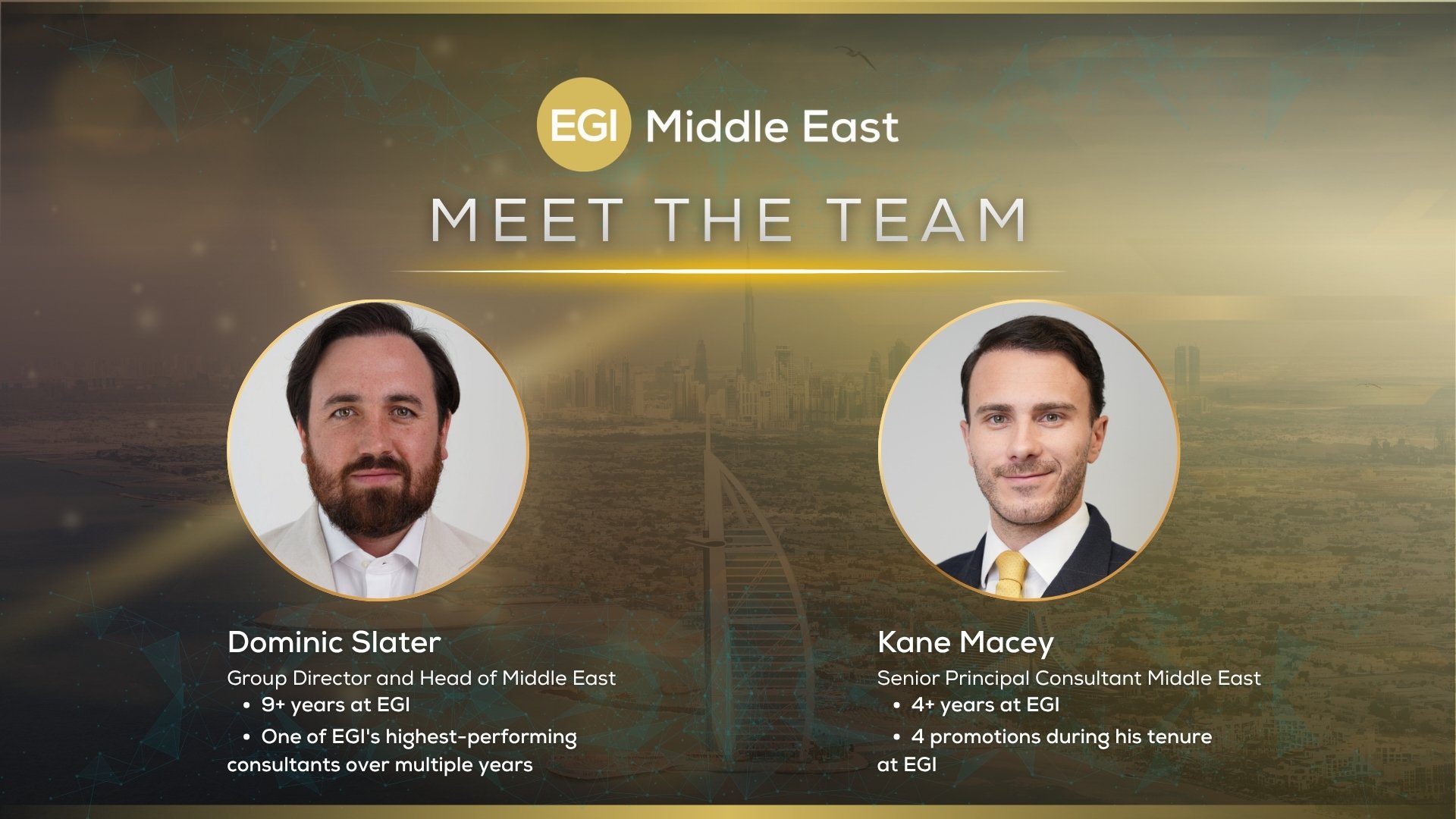
🔹Dominic Slater (Group Director & Head of Middle East)
🔹Kane Macey (Senior Principal Consultant – Middle East)
Spearheading EGI’s expansion into the Middle East are two of our most senior and experienced consultants from our London headquarters – Dominic Slater and Kane Macey. With 15+ years of combined experience delivering market-leading staffing solutions across our global network, and an already well-established presence across the Middle East region, Dominic and Kane were the natural choice to lead this next chapter for EGI.
Having worked alongside one another at our London HQ for over 4+ years, they bring not only deep industry expertise but a proven, trusted partnership to the role. Both now permanently based in the heart of UAE’s corporate district, they are uniquely positioned to offer clients and candidates across the region a truly local, senior-led service – backed by the full strength of EGI’s global network.
Check Out the New Dubai Office
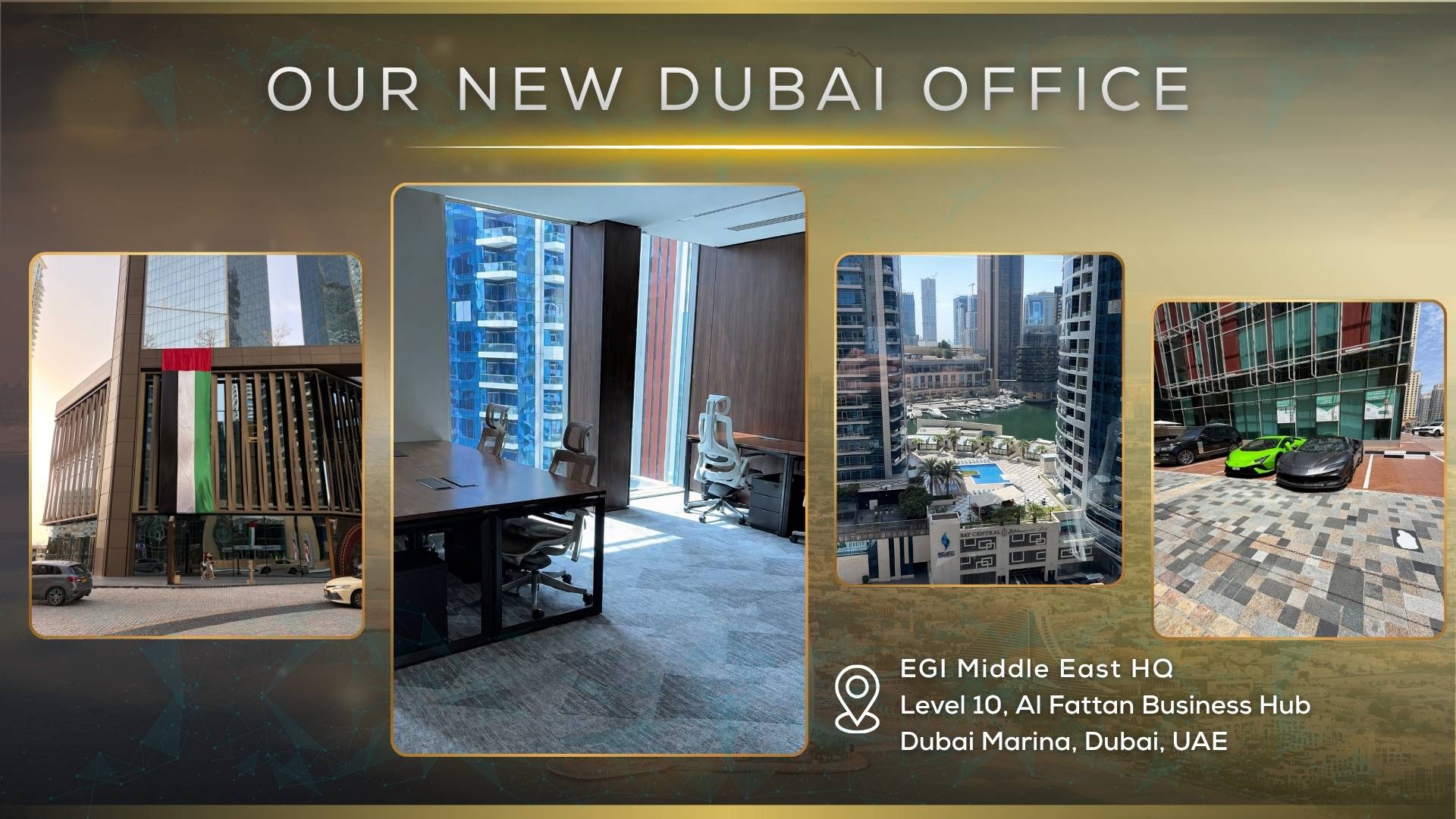
Situated at Level 10, Al Fattan Business Hub, Dubai Marina, our new office places EGI Middle East at the very heart of one of the world’s most exciting and fast-evolving business districts – precisely where we need to be.
Dubai Marina is a hub of commercial energy, attracting forward-thinking businesses and global talent in equal measure. From here, Dominic and Kane are perfectly positioned to serve:
- Dubai – supporting existing and new clients across the city’s thriving corporate and financial landscape
- Ras Al Khaimah – deepening relationships in one of the UAE’s fastest-growing business corridors
- Wider neighbouring regions – extending EGI’s reach across the broader Middle East with a locally embedded, senior-led team
The Focus of EGI Middle East
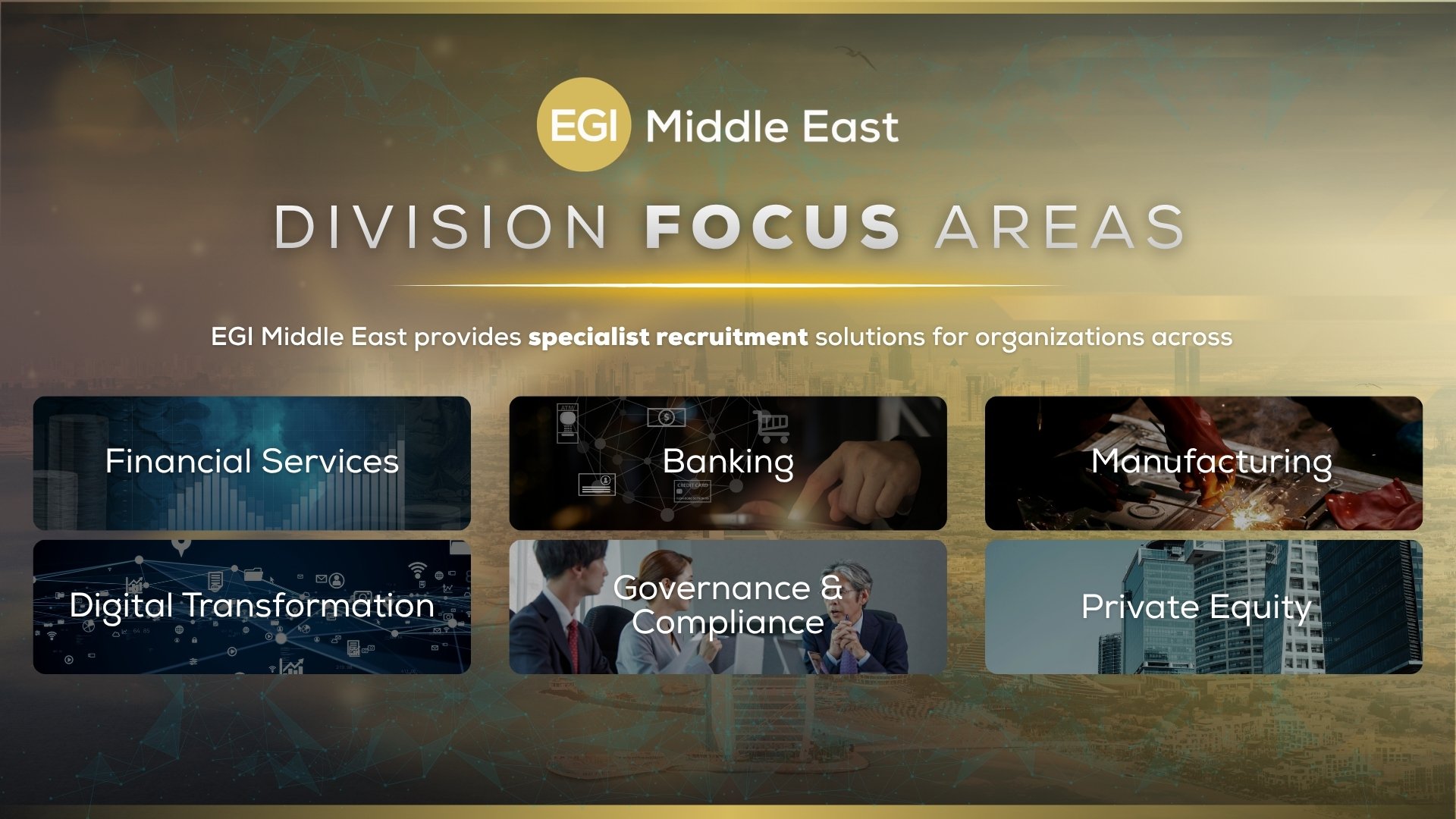
As the UAE & broader Middle East continue to cement their reputation as a global centre for business, our presence here is both timely and intentional – sitting at the intersection of the sectors we know best:
- Banking
- Digital Transformation
- Governance & Compliance
- Private Equity
- Financial Services
- Motor Vehicle Manufacturing & Industrial Manufacturing
With a tried and tested method of sourcing and placing top-level candidates into niche roles, our value, skillset and specialist solutions remain largely the same. We are now even more flexible and dynamic in our service range – alongside a newfound focus to bring the best talent to partners in the Middle East region.
A Note to Our Clients and Partners
To all of our existing clients and partners: nothing changes except our capacity to serve you better. All current partnerships will be fully honoured, and with Dominic and Kane now operating on local time in Dubai, you will have dedicated support closer to where you need it.
To organisations scaling within the UAE and wider Middle East – whether you are entering the region for the first time or accelerating existing operations – we would love to hear from you. This is an exciting moment for EGI, and we are ready to work alongside ambitious businesses looking to build world-class teams.
Get in Touch
Dominic Slater (Group Director & Head of Middle East)
📧 dominic.slater@expertsgroupinternational.com
Kane Macey (Senior Principal Consultant – Middle East)
📧 kane.macey@expertsgroupinternational.com
For any enquiries regarding our services or opportunities, please feel free to message us via our contact page. We will be happy to assist you.
Key Account Management in Industrial Manufacturing
Why is it one of the most critical and misunderstood roles in modern industry?
In industrial manufacturing, growth doesn’t just come from winning new clients. It comes from expanding, protecting, and strategically developing existing ones. That’s where Key Account Management (KAM) becomes critical. Yet despite its importance, many businesses still underestimate the impact a high-performing Key Account Manager can have on revenue, customer retention, and long-term competitiveness.
The Strategic Importance of Key Account Management
Key Account Managers sit at the intersection of commercial strategy and operational execution.
And the data supports just how important that role is:
- Improving customer retention by just 5% can increase profits by 25–95% (source)
- Around 65% of revenue in many businesses comes from existing customers (source)
- Effective key account strategies can drive 5–10% revenue growth within large accounts (source)
In industrial manufacturing – where contracts are complex, margins are tight, and relationships are long-term – this becomes even more pronounced.
Your largest customers are not just revenue streams. They are strategic assets that need to be actively developed.
In short:
Your biggest customers are your biggest opportunity – or your biggest risk.
What a Key Account Manager Actually Does
At a surface level, Key Account Managers manage client relationships.
In reality, their role is far more commercially critical.
They act as the central interface between the customer and the business, working across:
- Purchasing
- Engineering
- Quality
- Logistics
But beyond coordination, they drive growth, profitability, and long-term partnership value.
Some core Key Account Management responsibilities include:
- Acting as the primary point of contact across multiple customer functions
- Managing existing business while identifying new project opportunities
- Leading commercial negotiations (pricing, cost structures, contracts)
- Driving product diversification and new technology adoption
- Coordinating internal teams to ensure delivery and customer satisfaction
- Monitoring profitability, forecasts, and financial performance
- Staying ahead of customer strategy, market trends, and product roadmaps
This is not a reactive role.
It’s a proactive, commercially driven position that directly influences revenue.
Where KAM Fits in the Bigger Picture
In high-performing manufacturing businesses, Key Account Managers are not just relationship managers.
They are:
🔹 Revenue Drivers
They increase share of wallet within existing customers — often the most efficient growth lever in B2B.
🔹 Strategic Advisors
They align internal capabilities with customer roadmaps and long-term demand.
🔹 Internal Connectors
They bridge the gap between commercial, engineering, and operational teams.
🔹 Customer Experience Owners
Because in large accounts, service and support can outweigh product features in buying decisions (source)
Why This Role Is Hard to Get Right
Despite its importance, hiring the right Key Account Manager is difficult.
Because the role requires a rare combination of:
- Commercial acumen
- Technical understanding
- Stakeholder management
- Strategic thinking
- Negotiation capability
Too often, businesses hire:
- Pure sales profiles without technical depth
- Or technical profiles without commercial ability
The best performers combine both – and are increasingly in demand.
Who Should Consider Moving Into Key Account Management?
For candidates, KAM offers one of the most attractive career paths in industrial manufacturing.
Strong transition profiles include:
🔹 Sales / Business Development Managers
Looking to move into long-term, strategic account growth
🔹 Application Engineers / Technical Sales
With customer exposure who want to become more commercially focused
🔹 Program / Project Managers
Experienced in delivery, coordination, and stakeholder management
🔹 Supply Chain or Operations Professionals
Who understand the full value chain and want to step into a client-facing role
The Future of Key Account Management
The role is evolving rapidly.
Today’s Key Account Managers are expected to:
- Deliver personalised, omnichannel customer experiences
- Navigate increasingly complex global supply chains
- Support technology and sustainability transitions
- Act as long-term strategic partners to clients
And expectations are rising:
Nearly 80% of B2B customers will switch suppliers if key expectations aren’t met (source)
The bar for customer relationships is higher than ever.
Final Thought
In a market where: New business is harder to win, competition is increasing, and margins are under pressure. The companies that succeed will be those that maximise the value of the clients they already have.
And that starts with hiring the right Key Account Managers.
We’re Hiring Key Account Managers
We’re currently supporting several opportunities across industrial manufacturing and motor vehicle manufacturing:
- Senior Key Account Manager – Germany – Apply Here
- Key Account Manager – Poland (remote) – Apply Here
- Key Account Manager – Germany – Apply Here
If you’re:
Hiring for similar roles or considering your next move. We’re happy to share real-time insight and opportunities in the market.

The software-defined vehicle has arrived. Has your talent strategy kept up?
The modern vehicle is no longer a mechanical product with software bolted on.
It is a software platform on wheels – and the talent required to build, develop, and scale it looks nothing like the workforce that built the industry before it.
In 2026, automotive technology companies are navigating one of the most complex hiring landscapes in the sector’s history. The opportunity is enormous. So is the challenge.
The scale of the shift in Automotive Technology hiring
By the close of 2025, over 7.6 million software-defined vehicles were on the road globally. These next-generation platforms require real-time system updates, seamless connectivity, and increasingly autonomous features – demanding a workforce that combines embedded systems expertise, AI integration capability, and cybersecurity knowledge in a single profile.
The U.S. automotive sector alone projects a 26% increase in software developer roles by 2031. And demand for engineers who understand Agentic AI for smart manufacturing and in-cabin diagnostics has already surged by 20% in 2026 alone. (source)
Tier-1 Companies are no longer just competing with their automotive peers for this talent. They are competing with Silicon Valley, hyperscalers, and defence contractors – all chasing the same specialised profiles.
Our most recent data insights show that the motor vehicle manufacturing industry is losing this talent at a significant rate to other industries, such as:
- IT Services and Consulting are gaining SAP & senior talent at a 6 to 1 ratio
- Computer and Network Security are gaining senior talent at a 4.5:1 ratio
- Financial Services are gaining senior SAP talent at a 3:1 ratio
With top talent leaving the industry at this rate, Tier-1 companies must have a credible, efficient recruitment process in place to retain talent from competing industries in the near future.
The information gap nobody is solving fast enough
The single biggest challenge in automotive technology recruitment in 2026 is not a shortage of engineers. It is a shortage of engineers who can operate across both worlds.
Most candidates are skilled in either mechanical engineering or software development – but rarely both. Bridging this gap through strategic hiring and targeted upskilling has become the number one priority for HR leaders and hiring managers across the sector this year.
ADAS integration, OTA-enabled software updates, V2X communication, and AI-driven autonomy all require professionals who understand the full stack – from the hardware architecture to the software layer sitting on top of it. That profile is rare. And it is in exceptionally high demand in 2026. (source)

What the best candidates in automotive technology actually want in 2026
The professionals who hold these hybrid profiles know their value — and they are selective about where they take it. (source)
Here’s what our technology division hears consistently from senior automotive technology candidates across Europe, the UAE, and the US:
- Mission and product: the best engineers want to work on problems that will define the next decade of mobility, not maintain systems from the last one
- Speed of innovation: candidates at companies like Harman and Qualcomm are drawn to environments where the pace of development matches their ambition
- Global exposure: cross-border mandates, international teams, and projects with genuine global reach are increasingly non-negotiable at senior level
- Packages that reflect the market: base salaries, equity, and performance incentives have all moved significantly in the last 18 months across automotive technology
- The right representation: the most sought-after profiles are not browsing job boards. They are being reached through trusted specialist networks
Where specialist automotive technology recruitment changes the outcome
If you are a hiring manager scaling an automotive technology team in 2026, here is how a specialist recruitment partner changes the outcome:
Step 1 – Define the brief with someone who already speaks your language
A specialist automotive technology recruiter understands ADAS architecture, OTA integration, SDV programme structures, and Tier 1 supplier environments without needing educating. Your brief gets translated into action immediately — not after three rounds of explanation.
Step 2 – Access talent your competitors cannot reach
The best ADAS software architects, embedded systems leads, and connected mobility specialists are not browsing job boards. They are mid-project, mid-promotion, and only accessible through established specialist networks. Our global pool of 50,000+ verified technology specialists includes the passive talent you need but cannot find yourself.
Step 3 – Move at the speed the market demands
Senior automotive technology candidates move fast. A specialist recruiter with pre-qualified, warm relationships can compress your time to shortlist significantly – keeping the best people engaged before a competitor makes their move.
Step 4 – Have the right conversations with the right people
Approaching a senior engineer at Qualcomm, Harman, or Marelli about a career-defining opportunity requires technical credibility and discretion in equal measure. A generalist recruiter cannot do this convincingly. A specialist can — and does, every day.
Step 5 – Receive a shortlist that is genuinely a shortlist
Every candidate we present has been personally vetted, technically assessed, and confirmed as genuinely relevant to your brief. No volume. No padding. Just the right people, presented at speed.
The automotive technology talent market in 2026 is not waiting for anyone.
Software-defined vehicles are already on the road at scale. Demand for ADAS, embedded systems, and AI-capable engineers is accelerating faster than the talent pipeline can supply. Tier-1 Automotive Companies are competing not just with each other – but with Silicon Valley, hyperscalers, and finance firms for the same profiles.
The organisations that will win are not necessarily the ones with the biggest budgets. They are the ones that move with precision, engage the right partners early, and treat talent strategy as a core business function – not a reactive one.
The evidence is clear. The skills gap is real. The window to act is now.
🔵 For hiring managers and talent leaders in automotive technology
If you are scaling a team across ADAS, software-defined vehicles, embedded systems, or connected mobility, our technology division is ready to move with you. We bring sector expertise, a verified global network of 50,000+ specialists, and a process built for speed without compromise.
> Get in touch today for a confidential conversation about your hiring requirements.
🟢 For senior specialists and engineers in automotive technology
If you are an experienced professional across ADAS, embedded systems, AI integration, cybersecurity, or connected mobility — and you are open to understanding what the market has to offer in 2026 – we would love to hear from you. The most compelling opportunities rarely get advertised. They get filled through the right conversations.

The $162 billion problem hiding inside your SAP and manufacturing talent strategy
The factory floor has changed. The ERP landscape has changed.
But for many organisations across Europe, the talent strategy hasn’t kept pace.
In 2026, industrial manufacturing jobs across Europe are multiplying faster than the qualified talent pool to fill them. At the same time, SAP S/4HANA recruitment has become one of the most competitive and time-pressured hiring challenges in the market. The companies pulling ahead are the ones that recognised this early. Here’s what the data is telling us.
The manufacturing talent crisis is not a future problem.
According to a joint report by Deloitte and the Manufacturing Institute, the sector may need up to 3.8 million new workers by 2033 – with as many as 1.9 million of those roles at risk of going unfilled if current trends continue.
The latest data from the U.S. Bureau of Labor Statistics puts unfilled manufacturing positions at 415,000 as of December 2025. The picture across Europe is no different. As BDO’s 2026 Manufacturing Industry Predictions report notes, the real challenge is a specialisation gap – demand for professionals who combine deep technical knowledge with digital fluency, ERP transformation talent, and operational leadership.
That profile is rare. And it is in demand everywhere for these candidates.
The Simulacra 2026 State of Hiring in Manufacturing report puts it plainly: the defining challenge this year isn’t a shortage of open industrial manufacturing jobs. It’s converting them into actual hires in an increasingly competitive market for skilled talent.
For businesses navigating this, partnering with a specialist industrial manufacturing recruitment agency is no longer a nice-to-have. It is a strategic necessity.
The SAP deadline nobody is talking about loudly enough.
Running in parallel to the manufacturing talent squeeze is a ticking clock that every ERP-reliant organisation across Europe needs to be aware of.
December 2027 marks the end of SAP maintenance for legacy ERP versions. Every organisation that hasn’t migrated to SAP S/4HANA by then faces a compliance and operational risk it cannot afford to ignore.
The problem? SAP S/4HANA recruitment has never been harder. According to specialist firm Cedar Stone’s 2026 SAP Hiring Trends report, the ERP transformation talent required to execute these migrations is scarcer than most project leaders realise. Nearly half of SAP users report a lack of qualified S/4HANA specialists – and the shortage is deepest in the most critical profiles: consultants with hybrid SAP, AI, analytics, and cloud capabilities.
Industry analysts estimate that unfilled SAP roles and stalled migration projects are responsible for approximately $162 billion in lost revenues globally. That number is not theoretical. It is happening now, in organisations that underestimated how difficult it would be to find the right ERP transformation talent at the right time.
What private equity hiring trends are telling us
For organisations within PE-backed structures – or those expecting acquisition or investment activity – the talent picture is particularly important to understand.
Private equity hiring has accelerated sharply in 2026. BDO’s Private Equity Industry Predictions report notes that PE firms are increasing their focus on mid-market manufacturers, attracted by scalable operations and multiple levers for value creation. The talent strategy inside those businesses is increasingly part of the investment thesis – not a secondary consideration.
Here is what the data tells us about where private equity hiring pressure is building right now:
📊 68% of US and UK portfolio companies make at least one senior leadership hire every year — with average holding periods now stretching beyond six years, leadership continuity has never been more critical (source)
👔 CRO, CCO and CGO roles are now overtaking CFO as the most in-demand executive hires inside PE-backed businesses — as value creation shifts from financial engineering to revenue growth and commercial scale (source)
⚡ PE operating groups have more than doubled in size since 2021 — with engagement on IT and technology infrastructure up 13 percentage points, and procurement and supply chain up nine percentage points across portfolio companies (source)
🤖 Most portfolio companies are behind on AI – not because they don’t believe in the technology, but because they lack the leadership to apply it in a way that produces real ROI. By mid-2026, dedicated AI operating partners will move from experimental to critical (source)
🏭 74% of US portfolio company leadership roles are filled through external appointments – underscoring the critical role that specialist executive search partners play in delivering the right talent at the right time (source)
🔍 PE-backed organisations face a constrained executive talent pool in 2026 – as longer holding periods, delayed exits, and operational pressure keep experienced leaders locked into existing roles, making specialist search more important than ever (source)
The organisations that approach PE-backed transitions with the right talent already in place are significantly better positioned than those scrambling to hire mid-transformation. This is where manufacturing executive search becomes a critical capability – not just a recruitment function.
Where specialist recruitment makes the difference
This is the reality most hiring managers across industrial manufacturing and SAP already know, but don’t always act on quickly enough.

A generalist recruiter will be unqualified to identify an SAP S/4HANA functional consultant with proven migration experience in an industrial manufacturing environment. They cannot discreetly approach a passive ERP programme director who is mid-project at a competitor. And they cannot deliver the speed and precision that private equity hiring demands.
The data backs this up clearly:
- 70–75% of the workforce are passive candidates — professionals not actively job hunting but open to the right opportunity. Generalist recruiters relying on job boards simply cannot reach them (source)
- Direct specialist sourcing delivers results 5X faster than traditional job board posting — The best candidates are off the market within 10 days — in specialist markets like SAP, industrial manufacturing, and automotive supply chain, slow processes don’t just delay hiring. They end it (source)
- Job boards generate 49% of applications but account for only 24.6% of actual hires — the vast majority of quality hires come through proactive, relationship-driven outreach (source)
- The average cost of a bad hire reaches up to 3X to 4X times the employee’s annual salary at executive level – making precision and sector knowledge in the shortlisting process a direct financial safeguard (source)
- Proactive outbound sourcing is five times more likely to result in a hire than inbound applications — the competitive advantage in specialist recruitment is not volume, it is the quality of established relationships with candidates who are not looking but would move for the right opportunity (source)
Automotive manufacturing recruitment presents the same challenge. The best supply chain directors, purchasing leads, and operational executives in the European automotive sector are rarely actively looking. Reaching them requires a specialist network, and a consultative approach that addresses their motivations and concerns – not a job board.
This is precisely what a dedicated industrial manufacturing recruitment agency delivers. Pre-vetted talent pools. Established relationships with passive candidates. Deep knowledge of the certification requirements and module expertise that separate a good shortlist from a great one.
Our Value Chain division provides manufacturing executive search and specialist talent placement across industrial manufacturing, SAP S/4HANA recruitment, ERP transformation, automotive manufacturing recruitment, and private equity hiring — from project engineers and ERP consultants through to programme directors and C-suite executives across Europe and beyond.
With a global network of 50,000+ verified specialists, we don’t wait for the right candidate to apply. We find them before your competitors do.
For hiring managers and clients
If you are scaling a team, managing an SAP S/4HANA migration, preparing for a PE-backed acquisition, or looking to deploy specialist talent into a live transformation project, Our Value Chain division works exclusively across industrial manufacturing, automotive, ERP transformation, and private equity-backed businesses.
We move quickly, we know your market, and we already have the candidates you need in our network.
Enquire here to get in touch today for a confidential conversation about your hiring requirements.
For senior candidates and specialists
If you are an experienced professional in industrial manufacturing, SAP, ERP transformation, or automotive supply chain, exploring what the market has to offer in 2026
Apply to our relevant open roles today and let us find the opportunity your career deserves.

The Talent Behind the Energy Transition – And Why the Race to Secure It Is Accelerating in 2026
The energy transition won’t be won by technology alone. It will be won – or lost – by the people who design, build, operate, and scale it.
And right now, in 2026, the gap between the talent the industry needs and the talent it can actually find has never been wider.
The Numbers Tell a Stark Story
According to a joint study by Kearney and the IEEE Power and Energy Society, the power industry will need between 450,000 and 1.5 million additional engineers by 2030 – more than double today’s workforce. Up to 40% of global power executives already identify insufficient skills and competition for talent as their two biggest hiring challenges.
The IEA has been equally direct. Its World Energy Employment report warns that clean energy job opportunities “are not being filled quickly enough,” with skills shortages particularly acute in engineering, power systems, and specialist technical roles.
Meanwhile, on the AI infrastructure side of our industry, the data is just as stark. According to IEEE Spectrum, the number of companies competing for the same pool of specialised data centre engineers has nearly tripled in the past few years alone. An estimated 340,000 data centre positions could go unfilled by the end of 2026 without major intervention — roles spanning power systems engineering, high-voltage specialists, MEP engineers, liquid cooling technicians, and AI infrastructure specialists.
The Uptime Institute found that 51% of data centre operators struggled to find qualified candidates in 2024. That pressure hasn’t eased. It’s intensified.
Why This Matters for Companies Like Yours
The companies at the forefront of the energy transition – those building large-scale renewables, modular power systems for mission-critical environments, and AI-ready data centre infrastructure – are not competing against one another for talent. They are competing against everyone.
Hyperscalers. Defence contractors. Oil and gas firms retooling for clean energy. Tech giants are pouring hundreds of billions of dollars into infrastructure buildout. All are chasing the same pool of engineers, project managers, data centre specialists, and executive leaders.
And the specialist roles are the hardest to fill. As Actalent’s 2026 engineering workforce analysis notes, demand for engineering skills is projected to grow by 13% by 2031 – yet a third of new engineering roles go unfilled today because of retirements, increasing demand, and a persistent skills gap. This isn’t a headcount problem. It’s a specialisation problem.
The industry doesn’t lack engineers. It lacks the right engineers, with the right combination of technical depth, sector experience, and cross-disciplinary capability, in the right geographies, available at the right time.
What the Best Candidates Are Actually Looking For
Here’s what over a decade of placing engineering, infrastructure, and executive talent across CleanTech tells us: The best candidates in 2026 are not primarily motivated by title or base salary. They want to work on problems that matter. They want a mission they can articulate – not just a job description. They want exposure to the kind of technical challenges that will define their career for the next decade.
Companies that communicate this clearly – that frame their engineering culture, their global ambition, and their role in the energy transition as part of the offer – consistently outperform those that lead with compensation packages alone.
The IEA noted it plainly in their research: communicating the mission – “we’re solving a massive problem for the planet, and we need your help” is critical to attracting the next generation of talent. That applies at every level. From graduate engineers to C-suite executives.

Where Specialist Recruitment Partners Change the Outcome
Here is the reality most hiring managers in CleanTech and AI infrastructure already know, but don’t always act on quickly enough:
A generalist recruiter cannot shortlist a power systems engineer with modular UPS experience for a mission-critical data centre build. A generalist recruiter cannot identify a data centre infrastructure director who has navigated hyperscale builds across multiple jurisdictions. And a generalist recruiter certainly cannot discreetly approach a passive C-suite candidate at a competitor and have a credible conversation about a career-defining role.
As Empiric’s 2026 data centre market analysis found, hiring managers are increasingly moving toward specialist recruitment partners who understand mission-critical environments – partners who can connect clients with professionals who understand redundancy design, power systems, cooling performance, and compliance expectations.
That shift is not a trend. It is a necessity.
In a market where MEP engineer vacancies take an average of 4.2 months to fill and cause real project delays, speed and precision are strategic advantages. The difference between closing a transformational hire in six weeks versus six months is not luck. It’s the quality of the network, the depth of the sector knowledge, and the trust a specialist recruiter has built with the candidates you need – long before you knew you needed them.
Our CleanTech division works across the full talent spectrum: from data centre infrastructure engineers and power systems specialists to renewable energy project directors and C-suite executives. We work exclusively in the sectors where the energy transition is happening – which means the candidates we know, trust, and keep warm are exactly the profiles your competitors are trying to find.
The Opportunity Is Now
The global market for clean energy technologies is projected to exceed $600 billion annually by 2030. Data centres are projected to require $6.7 trillion in investment worldwide to keep pace with AI-driven compute demand, according to McKinsey. The race is on.
The organisations that move with intent – that treat talent strategy as a core business function and build the right partnerships to execute it – will be the ones who deliver on the ambition.
The ones that wait will find the talent has already moved.
- If you’re scaling a CleanTech or AI infrastructure team in 2026 Let us know your requirements here so we can find you top candidates quickly.
- If you’re a senior engineer, infrastructure specialist, or executive exploring what’s possible, apply for our open roles. We’d welcome a conversation.

The 180-Day Talent Blueprint We’re Seeing Scale PE Portfolio Companies
Private equity has changed.
Across the UK, Europe, and the Middle East, portfolio companies are facing longer hold periods, tighter debt markets, and more operational scrutiny than at any point in the last decade. For industrial, automotive, and engineered-product businesses in particular, value creation now depends less on financial structuring – and more on operational scalability. And scalability begins with talent. For boards and operating partners, the first 180 days post-acquisition determine whether the asset accelerates – or stalls.
Why the First Six Months Define IRR
Operational value creation now accounts for the majority of EBITDA growth in PE-backed businesses. In today’s environment, margin expansion is being driven by:
- Cost discipline and automation
- Lean manufacturing and waste reduction
- ERP modernisation and reporting visibility
- Compliance resilience and cyber readiness
- Engineering productivity and plant optimisation
However, McKinsey research consistently shows that around 70% of transformation initiatives underperform due to execution capability gaps – not strategy failure. (Source)
The challenge for boards is rarely what to do. It’s whether the organisation has the capability to execute – fast enough.
The Board-Level Dilemma: Restructure First or Build Capability First?
Many PE-backed companies, particularly carve-outs and industrial turnarounds, begin with cost controls and restructuring. But aggressive restructuring without a capability roadmap can remove critical middle-management and transformation talent – precisely the individuals required to deliver post-acquisition change.
The result:
- ERP projects stall
- Automation roadmaps drift
- Lean initiatives plateau
- Reporting remains fragmented
- Compliance risks increase
- High performers burn out
Boards are then forced into reactive hiring, contractor dependence, or delayed transformation timelines. The better-performing portfolios take a different approach. They treat the first 180 days as a capability acceleration window.
The 5 Critical Roles That Unlock Operational Scalability
Across large European industrial and engineered-product portfolio companies, the most effective post-acquisition scaling plans prioritise a small number of high-impact hires. Not volume hiring. Precision hiring.
1. Finance Transformation & Automation Leaders
Directors of Finance & Automation who can:
- Integrate ERP systems post-carve-out
- Standardise reporting across business units
- Improve margin visibility
- Reduce manual reporting headcount
Deloitte’s CFO Signals research shows automation and data transparency are now top strategic priorities for finance leaders across Europe. (Source)
One strong hire here can eliminate operational blind spots that otherwise delay board-level decision-making by months.
2. IT Compliance & Governance Managers
With regulatory pressure rising across the UK and EU – including data protection, cyber regulation, and emerging AI governance – compliance gaps now directly affect valuation and exit readiness. IBM’s 2024 Cost of a Data Breach report places the global average breach cost at $4.88 million. (Source)
For PE-backed businesses, cyber and compliance weaknesses now routinely surface during exit due diligence. Proactive hiring in IT compliance protects both EBITDA and valuation multiples.
3. Lean Manufacturing & Operational Excellence Leaders
In industrial and automotive portfolio companies, margin expansion is often found on the shop floor. McKinsey reports lean transformations can deliver 15-30% productivity improvements when executed effectively. (Source)
But lean requires experienced leadership – not theoretical frameworks. Plant Managers and Continuous Improvement Directors who understand post-acquisition pressure operate differently from steady-state operators.
They focus on:
- Rapid waste elimination
- Labour productivity
- Standardisation across sites
- Digitally enabled production reporting
4. Engineering & Systems Integration Leads
Many acquired assets run legacy systems and fragmented engineering processes.
Without technical integration capability:
- Automation projects overrun
- Maintenance costs rise
- Downtime increases
- AI and predictive maintenance strategies fail
Engineering leaders who combine operational knowledge with digital systems understanding create disproportionate ROI in early transformation phases.
5. Transformation Programme & PMO Talent
Strategy rarely fails on paper. It fails in coordination.
Technical Programme Managers and Transformation Leads ensure:
- Cross-functional accountability
- Timeline discipline
- Cost tracking
- Milestone transparency
In complex portfolio environments, this role prevents value leakage.
A Practical 180-Day Talent Deployment Blueprint
Boards and senior hiring managers can reduce execution risk by implementing a structured approach:
Phase 1 (0–60 Days): Capability Audit
- Identify operational bottlenecks tied to missing skill sets
- Map transformation roadmap against current leadership strength
- Assess ERP, compliance, automation and production capability gaps
Phase 2 (60–120 Days): Precision Hiring
- Prioritise 3–5 high-impact roles
- Deploy interim contractors where speed is essential
- Avoid mass hiring without ROI clarity
Phase 3 (120–180 Days): Embed & Scale
- Integrate hires into transformation governance
- Align KPIs with EBITDA impact
- Build succession planning to stabilise capability
This approach reduces reactive recruitment and improves time-to-value.
Why Specialist Recruitment Partners Matter in PE Environments
Hiring in portfolio companies is different from corporate hiring.
Timelines are shorter.
Margins are tighter.
Board oversight is sharper.
Risk tolerance is lower.
Generic recruitment models struggle in this environment.
Scaling post-acquisition requires recruiters who understand:
- Carve-outs and restructuring dynamics
- Industrial and engineered-product environments
- Finance automation and ERP integration
- Compliance and governance pressures
- Operational excellence frameworks
At Experts Group International (EGI), our Value Chain team partners with PE-backed businesses across the UK, Europe, and the Middle East to:
- Conduct capability mapping aligned to value creation plans
- Deploy high-impact finance, IT and operational talent quickly
- Support both interim and permanent scaling strategies
- Reduce time-to-productivity in critical transformation roles
For boards, that means faster execution.
For hiring managers, that means stronger delivery support.
For candidates, that means access to high-impact transformation roles.
The Bottom Line
In today’s PE market, financial engineering is no longer the primary lever of value creation. Operational scalability is. And operational scalability depends on having the right people in the right roles within the first 180 days. The portfolios that treat talent as a strategic asset – rather than an administrative function – consistently outperform those that don’t.
If you are leading transformation within a PE-backed business and want to strengthen execution capability quickly, our Value Chain team would welcome a confidential discussion.
The first 180 days determine trajectory. The right hires determine return.

EGI – 10 Year Anniversary
This month marks 10 years of EGI. A decade of growth, relationships, and evolution. As we enter our next chapter, here’s a look at how we’re expanding our global footprint and building for the future.
To kick things off, we sat down with the leadership team who built this company from the ground up and asked them about the highs, the lows, and – most importantly – the secret behind building EGI into the multimillion-pound revenue company it is today.
EGI: 10 Years In The Making
Leadership featured in this video:
Ross Fraser (Founder & CEO)
Joe Kemp (Director & Head of Global Technology)
Dominic Slater (Director & Head of Global Value Chain)
Sonny Tovey (Director & Head of Global CleanTech)
Luca Bergonzi (former Vice President of CleanTech North America)
(Video production by Tyler Melville-Griffiths & Henry Prior)
A Statement from EGI Founder & CEO – Ross Fraser
New London Office
What better way to head into the next decade of EGI than with a brand-new office location in the heart of London?
Our London HQ is now based at 60 Moorgate, EC2R 6EL, with the majority of our team delivering international recruitment services from this location. The new environment has already ignited a fresh wave of energy, setting us up for another record-breaking year of growth and opportunity for both our clients and candidates.
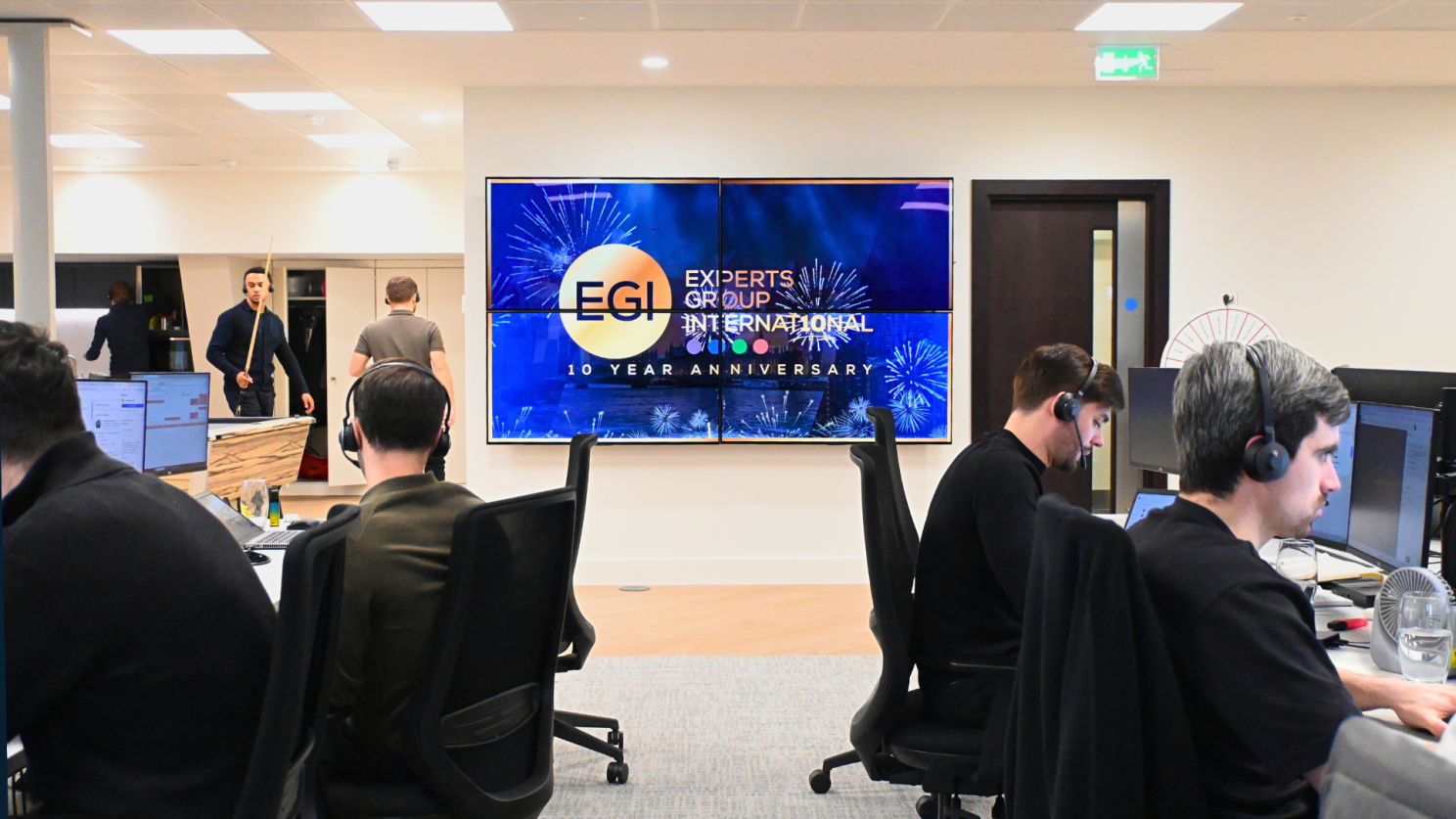
Austin Expansion & New Team
Having opened in April 2024, our North American office has gone from strength to strength, with core team members and leadership continuing to develop strong business partnerships across North America.
We have since further scaled the team to truly take EGI North America to the next level. It is with great pleasure that we formally introduce our EGI North America team.
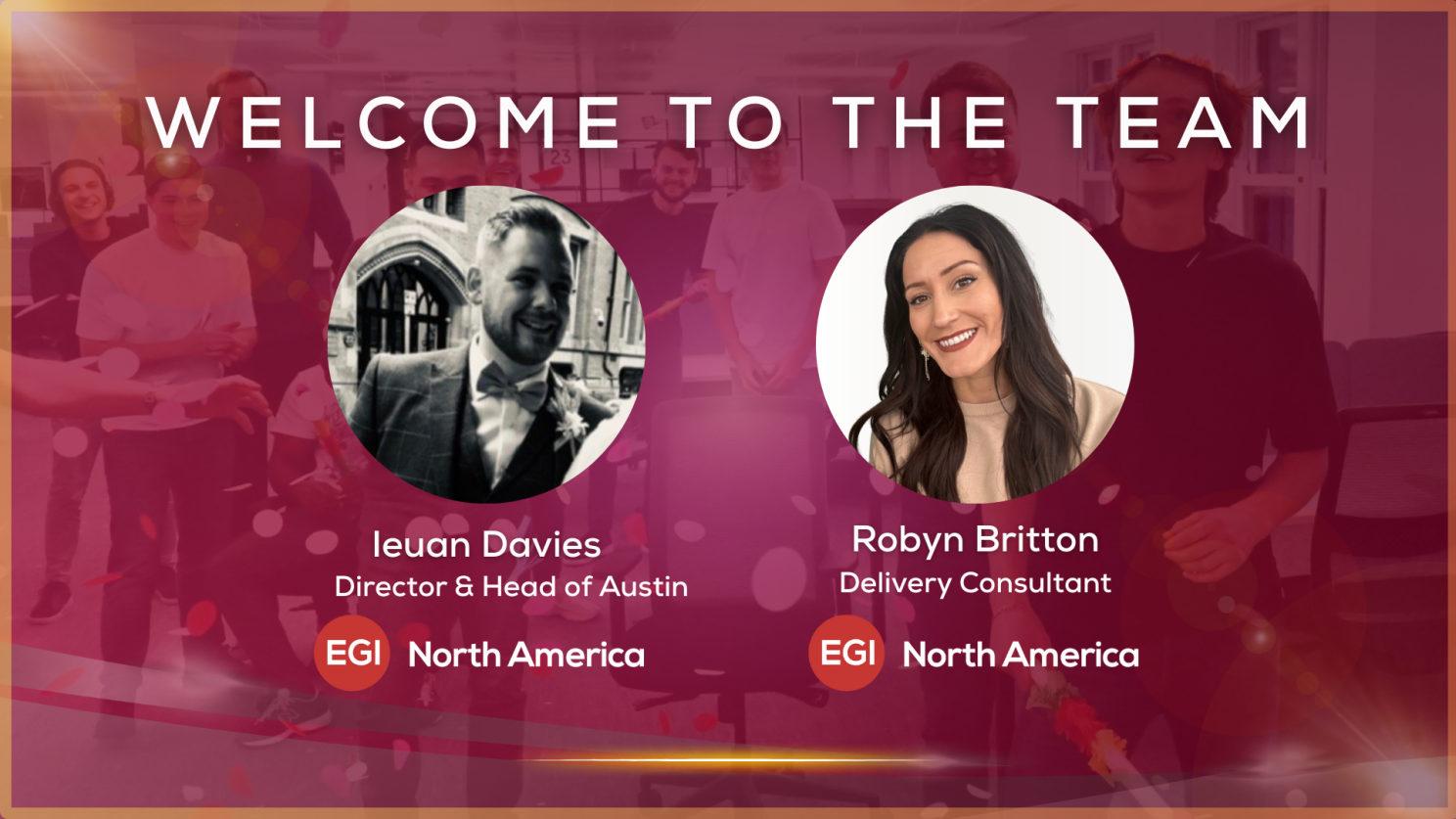
- Ieuan Davies– Director & Head of Austin
- Robyn Britton – Delivery Consultant
Be sure to connect with each of them if you are currently seeking professional opportunities or looking to scale your organization now or in the near future.
On the Horizon – Dubai Office
H1 2026 is set to be a pivotal milestone for the company, with the official opening of our second international office, confirmed as Dubai.
With key members of our leadership team spearheading the expansion and setting up the new HQ, one thing will remain unchanged: the values, work ethic, and proven recipe for success that have made EGI what it is today.
With growth and relocation opportunities available for both current and new EGI team members who demonstrate the right mindset and experience to make a real impact in this exciting region, we couldn’t be more focused on expanding the business to operate on a truly global scale with our market-leading staffing solutions.

Over the past 10 years, EGI has reached some incredible milestones. With multiple divisions continuing to achieve new highs in revenue and team performance – including across recent quarters – the foundations are firmly in place for Experts Group International to solidify its position as the go-to agency across CleanTech, Value Chain, and Technology.
From all of us at EGI, thank you to every candidate, client, consultant, and team member across our professional network for making the last decade truly unforgettable.
From day one, our goal was to build a business that accepted nothing less than excellence and created partnerships and opportunities on an international scale. After an incredible 10 years, we’re showing no signs of slowing down – in fact, this feels like just the beginning.


Building Depth, Autonomy and Leadership within Mission Critical – Francesco Cannella
In this edition of our Principal’s for Success Series, Henry Prior, Marketing Manager at Experts Group International (EGI), sits down with Francesco Cannella, Head of Mission Critical.
With over 10 years of experience as a consultant and recruitment leader, Francesco joined Experts Group International (EGI) five months ago to launch and run his own sub-division within EGI CleanTech. His focus: building a specialist desk within mission-critical infrastructure and scaling it with autonomy, intensity, and long-term vision.
Francesco has brought a unique combination of experience and focus to EGI CleanTech. As a proven market specialist, he leverages not only his recruitment expertise but also his personal branding and team management skills to ensure the deliberate, efficient growth of the subdivision.
In this interview, Francesco shares what truly separates a principal consultant from a senior consultant, what genuine specialisation looks like in practice, and why EGI provided the right platform for him to step into a meaningful leadership role.
How long have you specialised in your current vertical, and what originally drew you to this market?
Francesco:
I have specialised in this vertical for two years. I initially entered the sector with limited prior knowledge, but I was quickly drawn in by its complexity and significance. I invested considerable time researching mission-critical infrastructure sectors, the key stakeholders, the intricacies of the build and delivery processes, the scale of capital deployment, the global competitive landscape, and the strategic importance of coverage and resilience. These elements continue to fascinate and motivate me to deepen my expertise.
In your experience, what separates a strong principal consultant from a good senior consultant?
Francesco:
The key differentiators are depth of expertise, comprehensive market knowledge, superior objection handling, and an exceptional work ethic. While strong senior consultants perform very effectively, principal consultants distinguish themselves through their relentless drive to execute at scale, their continuous pursuit of improvement, and their ability to consistently operate at a significantly higher volume and intensity without compromising quality.
What does being a true specialist mean in your vertical — and how do you apply that day-to-day?
Francesco:
Being a true specialist goes far beyond simply presenting opportunities to candidates. It means actively listening, knowing when to pause and absorb information, and continuously building a detailed understanding of the technical, commercial, and operational realities of the roles and projects our clients deliver. This deep, industry-specific insight enables me to provide genuinely valuable, informed advice to both clients and candidates every day.
Was there a moment or realisation that confirmed specialising in this area was the right long-term move for you?
Francesco:
A defining confirmation came from the rapid and sustained growth of my industry network from zero to over 9,000 meaningful connections within two years. Beyond successful placements that deliver immediate and lasting value, I have also supported smaller organisations in securing positions on major supply chains, helping them access larger strategic opportunities. These outcomes have not only produced strong professional results but have also fostered genuine, long-term relationships across multiple levels and disciplines within the sector.
How do you use your experience to develop junior consultants – and what behaviours do you look for in those who progress fastest?
Francesco:
I focus on providing junior consultants with a thorough grounding in the full 360° recruitment lifecycle, delivering clear, structured, and digestible guidance alongside consistent, ongoing support. In return, I expect the same level of dedication and proactive effort. I actively champion progression for individuals who consistently perform above the expectations of their current level, as I remain personally committed to continuous professional growth.
When you joined EGI, what convinced you it was the right environment to step into (or grow within) a leadership role?
Francesco:
EGI offered genuine autonomy to shape and run the desk in the way I know delivers the best outcomes, combined with significant trust in my judgement regarding key processes, workflows, and strategic decisions. The opportunity to be directly involved in building and hiring the team further reinforced that this was the right environment for me to grow into a meaningful leadership position.
What qualities or approach do senior and principal consultants need to truly succeed at EGI?
Francesco:
A high-performance mindset, approachability, unwavering commitment, and a genuine drive for continuous improvement are essential. Consultants who thrive here consistently demonstrate these characteristics.
How would you describe EGI’s culture to an experienced consultant who’s worked in high-performance environments before?
Francesco:
EGI has a bold, energetic, and decisively action-oriented culture. It is a place where high-calibre professionals are trusted and empowered to get things done quickly and effectively.
For other senior or principal consultants considering EGI, what mindset or skillset do you think matters most here?
Francesco:
The most important attributes are strong intrinsic drive and a genuine commitment to proactive, high-volume activity, particularly picking up the phone and making things happen consistently and at pace.
What does EGI allow you to do in your role now that you couldn’t do earlier in your career?
Francesco:
EGI gives me the freedom and authority to design and implement proven processes and workflows that I know deliver strong results. Equally important, support is readily available whenever needed, enabling confident, decisive leadership of the desk.
If you are a client delivering mission-critical infrastructure projects, or a candidate seeking your next opportunity within this sector, Francesco welcomes the opportunity to connect. Whether you are hiring for current projects or exploring future moves across critical infrastructure, he is always open to a confidential conversation.
Considering Your Next Step as a Principal Consultant?
Francesco joined Experts Group International (EGI) just five months ago – but in that time, he has launched and is now leading his own Mission Critical sub-division within EGI CleanTech, operating with autonomy and strategic responsibility.
His experience reflects what we aim to offer experienced recruitment leaders:
- True market ownership
- Autonomy to design and execute proven strategies
- The opportunity to build and hire your own team
- A high-performance, action-oriented culture built on trust
If you are a Senior Consultant ready to step into principal level, or an established Principal Consultant seeking greater autonomy and long-term growth, we would welcome a confidential conversation.
Start the conversation with Ross Fraser today and explore how you could build and lead your own specialism within EGI.
The right platform makes the difference between billing well and building something exceptional.

Market Specialist to Principal Leader: An Interview with Darryl Leigh – Head of WTG & Blade Repair
Building a successful recruitment career at a senior level isn’t just about billing well – it’s about owning your market, building trust, authority, and developing others along the way.
In this interview, Darryl, Principal Consultant and Head of Wind & Blade at Experts Group International (EGI), shares his journey into renewable energy recruitment, what separates strong senior consultants from true principals, how he develops junior talent, and why EGI was the right platform for him to step into leadership.
Having made the 2nd-most amount of successful placements across the entire company in the last year, Darryl is a great example of what can happen when you build out your own market at EGI.
Interviewed by Henry Prior, Marketing Manager at EGI, this conversation offers a candid look at what high performance really looks like in a specialist recruitment environment – and what experienced consultants should look for when taking their next career step.
How long have you specialised in your current vertical, and what drew you into it?
Darryl:
So I’ve been doing my vertical now, I’m going to say three years roughly. The reason as to why or what drew me into that market is I think it comes down to just how busy the market is and how busy the vertical is. I know there is lots of work, there are a lot of projects – a lot of wind farms across the UK and Europe – and a lot of top developers and manufacturers. I wanted to get involved in that, I wanted to understand how that works and essentially bring my expertise into play in terms of supporting these clients. This wasn’t an overnight success for me. It was hard graft and a lot of hard work that went into it. But if you have A-star candidates in the vertical and you’re able to position them in the right way, you will create openings. I think a lot of people make recruitment more difficult than it needs to be, especially in my market. If you’ve got an A-star candidate with the right experience, you can confidently put them in front of clients and they will speak to them.
In your experience, what separates a strong Principal Consultant from a Senior Consultant?
Darryl:
I’d say it comes down to how well you know your market. The ones that really succeed know it inside and out. They know when projects are coming up, they know what clients are hiring, and they have very good relationships. A lot about recruitment is building relationships and trust. Being a successful Principal Consultant comes down to how well you can build relationships with your clients, how well you can build relationships with your candidates, and also your processes. If you can nail all three of those and know a lot about your market, you will be a success.
What does it mean to be a true specialist in your vertical?
Darryl:
I think being a true specialist in your market is that candidates and clients see you as their go-to number one recruiter. It comes down to people you’ve already placed with them who have performed well – that creates trust. When clients trust you, they come back to you when they have new requirements. Being a go-to market specialist comes down to knowing a lot. When you’re speaking to clients, they want to know how much you know. If you can speak to them about projects that are coming up, what they’re looking for, what an ideal candidate looks like, and match that to a candidate profile, it shows you’re a market specialist – not just someone trying to fill a role to earn a placement.
How do you use that experience to develop junior consultants?
Darryl:
Number one, I look for someone willing to learn. They need a good work ethic, motivation, and energy. I like helping people, but I can’t force people to learn – they have to want it themselves. A lot of teaching junior consultants in my market comes down to speaking to candidates. You learn so much by doing that. Candidates love talking about themselves, so if juniors don’t know something, I tell them to ask. Capture that information, let it sink in, and then use it in future conversations. I’ve been in their position before. When I started as a junior consultant, I turned to more experienced people for help. I always say: look at who’s doing well around you, take ideas, don’t necessarily copy them, but apply the same formula in your own way.
What convinced you that EGI was the right place to take the next step in your career?
Darryl:
Number one was having my own resourcer to manage. In my last role, I had a lot of jobs but not enough support. At EGI, I could focus on building the market and new business, and then pass roles to a junior consultant to find candidates. That team structure works really well.
Number two was leadership and growth plans. From my interview conversations, it was clear EGI invest in their people and give you a platform to succeed. The growth plans – offices in Austin, Dubai – showed ambition. Ross and the directors are always looking at how to grow the business and the brand. For me, it was a clear indication that I wanted to be part of this.
What qualities do Senior or Principal Consultants need to succeed at EGI?
Darryl:
It comes down to how much you want to succeed. Everyone has their own goals, and the effort has to come from you. Someone senior coming into the business needs to put in as much (if not more) effort than the seniors and principals already here. You’re expected to generate revenue, provide extra value, support junior consultants, and be a leader. Juniors look up to seniors and principals – they want to follow in their footsteps. It’s also about bringing new ideas to the team. But ultimately, it’s about giving 100% and working hard.
How would you describe EGI’s culture to someone from a high-performance environment?
Darryl:
The culture here is brilliant. We have a great team, no egos, no unnecessary competition. It feels like collaboration because of the strong relationships, but it’s also high performing. Recruitment is naturally performance-driven – what you put in is what you get out. Sometimes that means early mornings or late nights, but you’re working towards something. Enjoying work comes down to who you work with, and everyone here wants to see each other succeed.
What does EGI allow you to do in your Principal role that you couldn’t before?
Darryl:
One word: freedom. EGI has given me a platform to make myself as successful as I want to be – with the tools, support, and autonomy to focus on my niche and generate new business. Leadership is another big one. I was able to manage someone from day one, take more responsibility, and develop as a manager. That’s opened doors to new clients while my junior consultant focuses on finding candidates. I didn’t have that opportunity in previous recruitment companies.
Why experienced consultants should start a conversation with EGI
Darryl’s journey is a prime example of what many experienced Senior and Principal Consultants look for next: ownership of a market, leadership responsibility, genuine support, and the freedom to build something purposeful.
At Experts Group International, senior recruiters are trusted to lead, backed with the tools and resources to succeed, and supported by a culture that values collaboration over ego.
Whether your goal is to be a Principal Consultant in London, Dubai, or Austin, EGI offers a platform to take the next step in your recruitment career.
👉 If you’re an experienced Senior or Principal Consultant and want to start the conversation with us, apply today.
Let’s talk about how you can own your market, build a team, and grow your career as you see it at EGI.
Lastly, If you’re a client looking for scaling or a candidate seeking work opportunities across WTG & Blade Repair, Darryl is who you’re after.
Be sure to add Darryl to your network for current or upcoming opportunities.
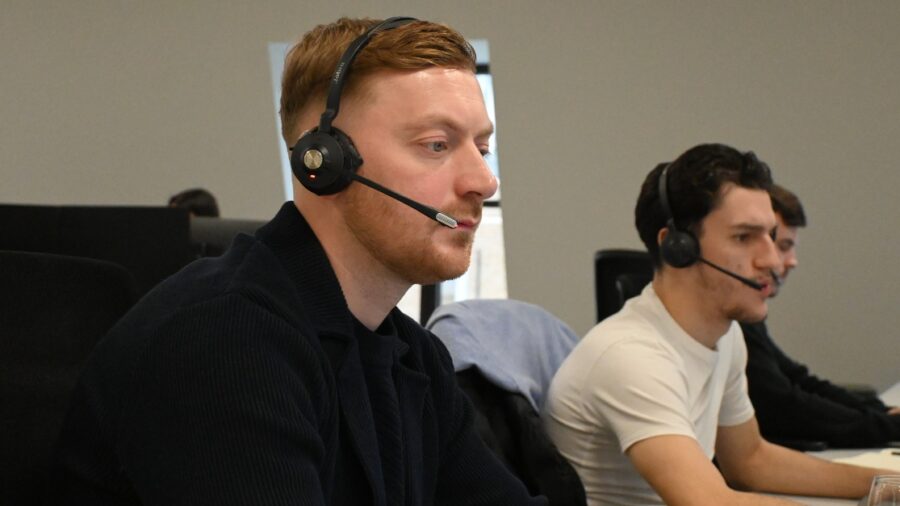
The Real Transformation Bottleneck: Capability Debt – and Why Strategic Hiring Fixes It Faster Than Reorganisation
Enterprise transformation is accelerating — but the talent required to deliver it is not. As large IT services and consulting organisations push deeper into AI, automation, cloud modernisation and large-scale restructuring, a new barrier is emerging:
Capability debt.
Like technical debt, capability debt is the accumulation of missing or outdated skills within engineering, ops, and transformation teams. And for organisations with 10,000+ employees, this gap is growing faster than most leaders realise. (source)
A 2024 McKinsey study found that 87% of executives already face skill gaps or expect them within the next two years, with engineering, cloud and analytics functions under the most pressure. And Gartner warns that “skill obsolescence” has overtaken “cost efficiency” as the top workforce risk for 2025. (source)
Capability debt now impacts delivery far more than process, tech, or tooling constraints.
Why Capability Debt Is Quietly Killing Transformation Programs
Unlike traditional hiring challenges, capability debt creeps in slowly:
1. Legacy skill sets can’t meet modern delivery demands
Across enterprise environments, many mid-level engineers and operations professionals were trained on traditional systems – not distributed compute, AI integration, or complex multi-cloud architectures.
This creates:
- Delayed migration timelines
- Increased dependency on external contractors
- Higher rework and QA costs
According to Accenture, migrations staffed with under-skilled engineers run 46% longer and cost 32% more. (source)
2. Restructures often reduce headcount before rebuilding capability
Large organisations are restructuring aggressively, but many unintentionally remove the very expertise needed to deliver the “new” operating model.
This results in:
- Teams are unable to execute revised workflows
- Excessive vendor reliance
- Overstretched high performers
When organisations lose high-impact capability before transformation begins, costs rise significantly – and timelines slip by quarters, not weeks.
3. AI’s rapid adoption is widening the skills chasm
The AI boom is driving a surge in data center construction, creating thousands of new roles across engineering, operations, and infrastructure management. As companies race to scale AI workloads, enterprises such as Nvidia, Amazon Web Services, Google Cloud, and Microsoft are expanding their data center footprints, generating demand for roles like:
- Data Center Engineers & Infrastructure Specialists: building and maintaining the physical and virtual backbone of AI compute.
- AI-Optimized Hardware Technicians: deploying GPUs, TPUs, and other high-performance AI accelerators.
- Cloud & ML Operations Engineers: ensuring scalable, low-latency access to AI models.
- Energy & Sustainability Managers: designing efficient power and cooling systems for AI-intensive facilities.
- AI Risk & Compliance Leads: overseeing governance as enterprises scale AI infrastructure globally.
The World Economic Forum predicts that by 2027, 60% of enterprise jobs will require AI augmentation or proficiency. (source)
Yet, most companies are still catching up, particularly in engineering and operations teams, where capability gaps are widening with every new AI deployment.
The expansion of AI-driven data centers isn’t just about servers and cables—it’s creating entirely new career pathways in a rapidly evolving technology ecosystem.
The Highest-Impact Roles to Prioritise – Backed by 2024-25 Hiring Data
Your demographic (mid-senior engineering/ops within enterprise IT services & consulting) cares about prioritisation. Here’s where the data says leaders must invest to reduce capability debt fastest.
1. Cloud & Platform Modernisation Roles
These are proving to be the biggest accelerators of transformation productivity:
- Platform Engineers
- Cloud Architects
- SREs
- FinOps Specialists
Cloud migration projects with Platform Engineering involvement are 3.5× more likely to meet deadlines, according to Puppet’s State of DevOps Report. (source)
2. AI-Enabled Engineering Talent
Not full AI teams – AI-augmented engineering functions:
- AI-ready DevOps
- Machine Learning Engineers
- DataOps Engineers
Gartner states that AI-augmented engineering will cut release cycles by 30–50% by 2027. Hiring now means outperforming competitors later. (source)
3. Operational Transformation & Systems Integration Roles
These reduce complexity and ensure new architectures actually work:
- Technical Program Managers
- Enterprise Integration Specialists
- Change & Transformation Leads
- Process Automation Engineers
McKinsey’s research shows companies that strengthen operational transformation roles see a 20-30% improvement in execution reliability across major programmes. (source)
4. Cybersecurity & Governance Talent
As IT estates grow more distributed, security becomes not just a requirement – but a delivery bottleneck.
High-impact roles include:
- Cloud Security Engineers
- Identity & Zero Trust Specialists
- AI Governance Leads
IBM reports that enterprises with modernised cybersecurity talent reduce transformation delays by 43%. (source)
How Enterprise Leaders Can Reduce Capability Debt in 90 Days
This is where your audience needs tactical instruction. Here are the highest-impact, lowest-friction actions:
1. Build a Capability Map – Not a Headcount Plan
Shift from:
“Which roles do we need?”
to
“Which outcomes are blocked by missing capability?”
This creates hiring that accelerates delivery, not just fills seats.
2. Use Transformation-First Recruitment
Enterprise hiring is traditionally reactive.
Transformation hiring must be proactive.
This includes:
- Pre-vetting engineering & operations talent
- Building rapid-deployment benches
- Using contractors to plug immediate skills gaps
- Converting proven contractors to perm after 3–6 months
It shortens hiring cycles and reduces risk at every phase of modernisation.
3. Integrate Recruiters Into Program Governance
Most organisations treat recruitment as an administrative function.
High-performing enterprises embed recruitment within:
- PMOs
- Architecture functions
- Transformation steering groups
This enables capability alignment before bottlenecks appear.
4. Benchmark Your Capability Debt Quarterly
Use metrics such as:
- Time-to-productivity
- Skill distribution across teams
- Program delays linked to skills gaps
- Vendor dependency ratios
Enterprises that reinvest based on capability metrics see 22% higher transformation success rates. (source)
Where Experts Group International Supports Clients
Clients – Reduce your capability debt before it delays another programme.
We provide:
- Capability Gap Audits
- Transformation-Ready Engineering & Ops Talent
- AI-Augmented Team Scaling
- Rapid Contractor Deployment for Change Initiatives
Candidates – Move into transformation-critical roles faster.
Join our active placement network for senior engineers & operations professionals.
Most large-scale transformation failures aren’t caused by technology.
They’re caused by capability gaps hidden inside engineering and operations teams.
Leaders who identify and close capability debt early:
- Deliver transformation faster
- Reduce vendor spend
- Prevent program slippage
- Build future-proof technical teams
Strategic hiring isn’t just a cost centre – it’s the most effective accelerator of enterprise change.
If you are responsible for restructuring or scaling for industrial digital infrastructure projects, we are experts in saving time and cost when it comes to key hires.
Upload your Vacancy to discuss your hiring requirements with one of our specialist consultants today.
Alternatively, if you are a digital infrastructure professional seeking work opportunities in this exciting market.
Apply for our open roles here, or upload your CV to join our network of over 50,000+ skilled professionals globally.
Lastly, for all the latest industry news, updates, and opportunities across niche industries, follow us on LinkedIn to stay on the cutting edge.

The Hidden Cost of Delay: How Slow Hiring Is Derailing Enterprise Change Programs
In large IT services and consulting organisations, the calendar is often the enemy of transformation. For mid-senior engineering and operations managers running change programs at 10,000+ employee firms, every week a key role sits vacant is a week of delayed deliverables, overloaded teams, and rising program costs.
The numbers show this is not a hypothetical risk – it’s a measurable drag on outcomes that smart leaders can fix.
Why time-to-hire matters more than ever
Hiring has become slower and more interview-heavy. Recruiters now run many more interviews per hire than they did just a few years ago, and that extra process length is adding up: overall time-to-hire increased roughly 24% since 2021, driven in part by an average rise in interviews-per-hire. (source)
Typical hiring cycles for major IT Services and IT Consulting companies
- Amazon‘s typical hiring cycle for mid-senior hires: up to 5 weeks
- Accenture’s typical hiring cycle for mid-senior hires: up to 6 weeks
- Cognizant’s typical hiring cycle for mid-senior hires: up to 6 weeks
- Google‘s typical hiring cycle for mid-senior hires: up to 7 weeks
- NVIDIA’s typical hiring cycle for mid-senior hires: up to 8 weeks
- IBM’s typical hiring cycle for mid-senior hires: up to 8 weeks
Worse, 60% of companies reported increased time-to-hire in 2024 – only 6% reported improvements – meaning delays are widespread across industries. That slowdown creates three direct problems for enterprise change programs:
- Delayed project milestones
- Higher unit costs for work that can’t be completed
- Greater risk of losing top candidates to faster competitors. (source)
The third is particularly dangerous, as this can be at the very end of the process, with considerable internal man-hours, interviews, and rejections having already taken place, compounding the cost & time of the first two problems.

The business cost of delay: not just recruitment fees
The real cost of a late hire goes beyond agency fees. For transformation projects, vacant roles mean:
- Lost velocity – sprints slip, integrations lag, vendor milestones delay.
- Hidden labour costs – scope shifts to existing staff, increasing overtime, and burnout.
- Opportunity costs – new capabilities (AI features, cloud migrations, automation) are postponed, eroding competitive position.
McKinsey’s body of work on transformations has repeatedly highlighted that execution – not vision – is the main reason projects fail; poor resourcing and slow capability build are common culprits. In aggregate, failed or delayed transformations cost the global economy hundreds of billions annually. (source)
How modern hiring problems create program risk
Three recruiting dynamics amplify risk for enterprise programs today:
- Longer, more fragmented interview processes. More interview stages increase candidate drop-off and slow decisions. Gem’s 2025 benchmarks show interviews per hire and days-to-hire have risen materially. (source)
- Underused recruiting specialists. Organisations that use recruiters in hiring typically move faster: external recruiters like EGI that specialise in hiring mid-senior level IT engineering and operations professionals in key growth regions will have a network of passive candidates who have been impactful at competing companies for specific transformation projects.
- Shift to flexible resourcing. Contract and fractional talent are becoming mainstream for transformation work; firms without a flexible bench end up either hiring slowly or overstaffing permanent roles. (This trend shortens time-to-productivity when leveraged correctly.) (source)
What senior engineering & operations leaders should do (practical game plan)
If you lead transformation or restructuring, here are high-impact actions to cut hiring time and reduce program risk – without sacrificing hire quality:
1. Prebuild capability pipelines for transformation-critical roles.
Don’t wait for headcount approval. Maintain a curated bench of vetted cloud, DevOps, data, and systems integration engineers – as we mentioned in our last article, these are people who can plug into projects quickly. This reduces time-to-productivity and prevents backlog.
2. Condense and parallelise interview loops.
Replace five sequential interviews with two parallel streams (technical + stakeholder fit) that converge. That reduces calendar churn and lowers candidate dropout without weakening assessment quality.
3. Use skills simulations, not just CV screens
Short, relevant simulations (pair programming sessions, architecture design exercises) surface real capability faster than long CV reviews – and they’re better predictors of on-the-job performance.
4. Adopt AI & or external consultants for triage
External sourcing, resume-matching, and calendar orchestration remove admin friction internally and save days in scheduling and shortlisting. Benchmarked data show recruiters & some form of AI usage cut hiring time significantly. (Source)
5. Blend contract-to-perm pathways into plans
If speed is essential, hire contractors for an initial 3–6 month term with a conversion pathway. This de-risks cultural fit and preserves momentum on transformation deliverables.
Quick metrics to track (recommended KPIs)
- Time-to-offer (days) – target: reduce by 30% in first 3 months
- Offer acceptance rate (%) – target: ≥70% for critical roles
- Time from open → first qualified interview (days) — target: ≤7 days
- Source-to-hire efficiency – which channels deliver fastest, best candidates
How Experts Group International helps
If you’re running an enterprise transformation, we partner with heads of engineering and ops to close these gaps quickly. Our consultants are specialists across:
- Hiring efficiency audits (we map your bottlenecks and produce a 30-day acceleration plan).
➤ Book a 30-minute hiring efficiency audit with our transformation team. - Transformation-ready talent benches (contract, fractional, and perm pipelines for cloud, DevOps, data & systems engineers).
➤ Request a curated bench for your next sprint. - Fast-track candidate support (for senior engineers seeking faster placement into transformation projects).
➤ Apply to our current roles and get matched to active, time-critical transformation roles.
Final thought
In transformation work, calendars kill more projects than technology. The organisations that win are those that treat hiring velocity as a core delivery metric and design recruitment as part of the change plan – not an afterthought. For mid-senior engineering and operations leaders in large IT services firms, the reward for fixing hiring speed is simple: faster outcomes, lower cost, and projects that actually deliver stated objectives.
Want help benchmarking your hiring process or building a ready-now bench for your next transformation sprint?
📩 Clients: Book a 30-minute Hiring Efficiency Audit with Experts Group International.
📩 Candidates: Join our network to apply for senior engineering transformation roles.

Engineering Hiring Trends: How Senior Leaders Slash Time-to-Hire Beyond 2025
2025 Engineering Hiring Trends: How Senior Leaders Slash Time-to-Hire
In 2025, the companies that win are those who don’t just hire more – they hire smarter. For senior engineering, operations, IT, and technical leadership, we speak to clients on a daily basis about their hiring needs, trends, and current process challenges. Time and again, we’re met with the pressure to: do more with less, hire faster, and avoid mis-hires that cost time, money, and morale.
As a leader in these domains, here’s what you need to know – and what you can act on – to make your next rounds of hiring a strategic advantage.
The Context: Hiring is slowing, costs are rising, and mistakes are expensive
Across global recruitment benchmarks, the signal is loud: time-to-hire is creeping upward. Gem’s 2025 report shows teams now conduct 42% more interviews per hire than in 2021, contributing to an average 24% increase in time-to-hire over that period. Gem: In the UK specifically, the average time-to-hire sits around 4.9 weeks (≈34 days) across the technology industry.(source)
Because hiring is slower, many hiring efforts can now carry hidden costs – delays in project execution, higher agency fees, or the risk of losing top candidates mid-process. In fact, 60% of companies reported their time-to-hire increased in 2024, with only 6% managing to reduce it. (source)
Meanwhile, the stakes of making the wrong hire are also mounting. SmartRecruiters notes that only 15% of leaders feel totally confident in their hiring decisions at the time they hire. (source) That means most organizations second-guess and adjust later, which often leads to churn, rehiring, and wasted time, money, and effort.
So, the question for senior leaders is: “How do I hire fewer, but more impactful, workers – faster and with less risk?”
What “impactful hires” look like beyond 2025 (and why they matter)
Rather than focusing on volume, the top 20% of your audience (senior/engineering/operations) should prioritise roles that move the needle. Critical hiring projects such as Change & Transformation, AI integration, or updating legacy systems are costing companies millions in potential revenue and time inefficiencies, so hiring correctly for these projects is crucial to see a return before a projected fix becomes an even larger cost burden.
Based on current trends, here are the hires that tend to yield outsized returns:
- AI / ML / Data Science engineers: As AI integration scales across products, firms need engineers who can go beyond feature-building to architecture, model deployment, and optimization. We identify AI, ML, and data engineer roles among the top-demanded technical positions in 2025, and who we advise you start with for related projects that are behind schedule. (source)
- DevOps / Infrastructure / Cloud Engineering: The backbone roles that enable rapid delivery, scalability, and robustness. Those who automate, containerize, and monitor systems reduce friction and accelerate feature velocity.
- Green / CleanTech / EV / Energy Systems Engineers: In sectors tied to sustainability and energy transition, skills in battery systems, power electronics, autonomous controls, and conversions are in short supply. Kelly Services predicts that semiconductor, Hyper hyperscale data centers, and heavy industrial manufacturing & engineering roles will remain high-pressure hiring priorities. (source)
- Technical Program & Delivery Leads: People who can coordinate large-scale, cross-disciplinary projects, removing blockers and aligning engineering, ops, and business stakeholders. Their value is often multiplicative.
Because these roles are strategic, they justify investment in sourcing, evaluation rigor, and candidate experience. Done well, they pay off in performance, retention, and downstream ROI.
5 Trends Shaping How You Hire in 2025 (and what senior leaders must lean into)
1. Skills over credentials.
The hiring landscape has shifted decisively toward skills-based recruitment. Emerging and future-focused technical skillsets such as AI, Digital infrastructure, and other emerging disciplines are in massive demand. So much so that formal degrees are no longer the gatekeepers they once were. Research shows that degree requirements dropped by 15% across AI, cybersecurity, and sustainability roles, whilst the ability to prove technical skills commands up to a 23% wage premium.
What to do: Replace rigid degree filters with demonstrable capability checks – coding interviews, micro-credential verification, or real-world simulations.
2. Flexibility isn’t a perk — it’s a baseline.
Over half of all engineers now work remotely, and 72% say they’re open to fully remote opportunities. Hybrid models are not just preferred; they’re expected. (source)
What to do: Design roles around hybrid or distributed frameworks. Benchmark compensation for both on-site and remote talent to stay competitive.
3. The rise of the flexible workforce.
Permanent positions are still favored by the working majority in the current job market – but project-based work is on the rise. Companies that can facilitate a variety of employment contract options will have the advantage, as they can secure key long-term talent and also ramp up project work quickly with freelancers and contract teams
What to do: Build a hybrid hiring model. Keep a curated bench of contractors, consultants, and interim leaders ready for rapid deployment alongside your permanent team.
4. Utilize established recruiters with niche networks
Companies using talented recruitment partners are seeing improvements, not only in time to hire, but also less churn and better attrition metrics by negotiating with pre-vetted candidates who are motivated to join and create impact.
What to do: Introduce a roster of recruitment consultants who have connections and experience in placing these critical hires within your competitors.
5. Interview fatigue is killing candidate engagement.
The number of interviews per hire has increased 42% since 2021, and every additional stage raises the risk of candidate drop-off. (source)
What to do: Streamline your process. Run technical, leadership, and culture interviews in parallel and lay out the predicted hiring process and length as soon as possible to all candidates. Give fast feedback and clear next steps to keep high-value candidates engaged.
How to halve time-to-hire without sacrificing quality
Here’s a senior-level playbook that marries speed with selectivity:
- Pre-build talent pipelines
Don’t wait until you need someone. Maintain active relationships (via communities, events, alumni) so passive engineers are warmed up when a role opens. - Use screening and simulations, not just CVs
Skip multi-hour technical interviews on screening. Instead, use short take-home tasks, coding challenges, or pair-programming sessions that reflect real work. - Parallelize evaluation stages
Don’t force a candidate to loop sequentially through 5 decision-makers. Run technical, leadership, and culture interviews in parallel rounds or days. - Offer clarity, speed & transparency
Give candidates clear timelines, feedback, and decision windows. A disjointed, slow process costs top candidates. In 2024, 60% of companies said their time-to-hire rose — often because candidate engagement dropped mid-funnel.(source) - Leverage contract-to-perm pathways
Hiring a contractor first (3–6 months) gives you a de-risked assessment of fit, upskilling, and alignment before committing to full-time. - Measure & optimize relentlessly
Define KPIs (time-to-offer, offer acceptance rate, source-to-hire by channel) and monitor them weekly. Use A/B tests: e.g. “Reduce stage 2 interviews by 1 and measure candidate drop-off.”
Why senior technology leaders choose to partner with Experts Group International
If you’re responsible for recruitment, engineering, or operations in a mid-to-large organization (1,000–10,000+ employees), you now know the challenges of the market. But execution is where many sponsors stumble: aligning stakeholders, sourcing elite talent, and managing process optimization.
At Experts Group International, our approach is built around:
- Sector-specialist recruiters who understand engineering, cleantech, supply chain, and value chain roles deeply.
- Embedded ops & analytics – live dashboards that let you see funnel performance, conversion, and bottlenecks.
- Flexible models – RPO, contract, fractional, or full-hire strategies adapted to your needs.
- Co-creation of your hiring model – we don’t just fill roles; we help you build hiring functions that scale.
If you’re ready to reduce your hiring cycle by up to 30%, cap mis-hire risk, and prioritise hires who drive growth – Talk to one of our specialist consultants today.
Subscribe to our newsletter for monthly insight, or get in touch to benchmark your hiring process. The slow, reactive hiring model is over – your next generation of strategic scaling starts now.

Scaling Sustainable Digital Infrastructure: What Organisations Must Get Right to Hire for Growth
The Digital Infrastructure Shift Is Already Here
Across the industrial and technology landscape, the conversation has moved from whether digital infrastructure will transform to how fast. Traditional data centres and centralised grids are being restructured to integrate renewable energy, AI-driven efficiency, and decentralised systems (iea.org). What was once a linear, hardware-driven environment is now a living ecosystem – connecting clean energy generation, digital operations, and the global supply chain.
This isn’t just a technological evolution; it’s a talent demand surge.
As the sector scales, organisations will need people who can bridge once-separate disciplines – from renewable engineering and data infrastructure design to supply-chain optimisation, software integration, procurement, and sustainability governance.
At Experts Group International (formerly Connecting Experts), we see this transformation daily: our clients are no longer just hiring “data-centre managers” or “energy specialists.” They’re building cross-functional, hybrid teams capable of scaling digital infrastructure in a low-carbon, data-intensive world.
What’s Driving the Digital Infrastructure Boom
Several forces are converging:
- Renewable Integration – Data-centre operators and industrial hubs are aligning with on-site solar, wind, and battery systems to cut emissions and reduce grid dependency.
- AI & Edge Computing – Real-time data processing closer to source is driving demand for regional, sustainable, energy-efficient facilities.
- Decentralisation & Resilience – The grid of the future is distributed; companies are investing in micro-grids, energy storage, and smart systems to remain operational under variable loads.
- Industrial Decarbonization – Heavy industries and manufacturing are transforming their operations to meet net-zero targets, creating demand for digital infrastructure that supports monitoring, automation, and carbon tracking across production lines (Source gov.uk).
- Regulation & ESG – Net-Zero roadmaps and corporate sustainability commitments mean digital infrastructure must be both resilient and responsible.
Each of these trends requires a mix of technical, strategic, and operational expertise. That’s where the competition for talent intensifies – and where hiring strategy becomes the defining factor in whether an organisation scales or stalls.
The Talent Challenge: Why Hiring Has Never Been Harder
The shift to sustainable digital infrastructure has exposed a global need for cross-industrial skills alignment. (gov.uk)
Many organisations still recruit in silos – hiring IT for IT, energy for energy, and manufacturing for manufacturing. But the coming years demand hybrid profiles: engineers who understand grid integration and software, leaders who can translate data-center strategy into ESG outcomes, and operations managers fluent in both digital and physical infrastructure.
Key gaps we see emerging include:
- Leadership roles – CTOs, Heads of Infrastructure, and Sustainability Directors capable of aligning business strategy with digital and renewable transformation.
- Mission-critical operations – Data-centre design, maintenance, and energy efficiency specialists who can deliver uptime while meeting carbon targets.
- Corporate and strategic functions – Procurement, supply-chain, and project professionals who understand both technology deployment and sustainability compliance.
- Skilled engineering – Electrical, mechanical, and systems engineers comfortable working at the intersection of energy, automation, and data systems, compatible with the transition to a sustainability-focused, digital infrastructure.
Recruiting for these positions isn’t just about finding experience – it’s about finding versatility, innovation, and vision. People who can collaborate across traditional divisions are the ones who will accelerate the transition and future-proof your business.
Building Cross-Functional Teams: The Key to Scalable Growth
To keep pace with this digital infrastructure shift, organisations must rethink how teams are structured and hired.
The most successful scale-ups and multinationals we work with share three core practices:
Hire for Hybrid Competence
Seek professionals who can bridge multiple domains – for instance, an electrical engineer who understands cloud infrastructure or a project manager with sustainability reporting experience.
Align Leadership Around Transformation
A sustainable digital infrastructure strategy must be driven from the top. Forward-thinking companies appoint cross-departmental leadership that blends technology, operations, and environmental responsibility.
Partner With Specialist Recruiters
Recruiting in emerging markets like digital infrastructure isn’t about volume – it’s about precision, strategy, and roadmap.
Specialist recruiters with networks across Technology, CleanTech, and Value Chain like ourselves can identify passive talent, assess cross-functional fit, and help structure teams that are ready to scale globally.
At Experts Group International, we combine these vertical insights to deliver leadership, engineering, and corporate talent that accelerates transformation, not just fills headcount.
The Often Overlooked Enabler: Value Chain and Technology Talent
Behind every renewable data centre, energy park, or digital infrastructure rollout sits a complex global value chain – and the people who manage it determine how efficiently, sustainably, and profitably that project scales.
Private Equity & Finance:
Investment into digital infrastructure is surging, but capital deployment depends on leaders who can evaluate technology risk, ESG compliance, and long-term operational ROI. Hiring senior professionals in PE and infrastructure finance who understand both the digital and renewable landscapes is critical to ensuring sustainable growth.
Procurement & Supply Chain:
As companies seek to decarbonise supply chains, procurement professionals must secure sustainable materials, energy-efficient components, and localised production models. Talent with experience in global vendor management, modular manufacturing, land acquisition, and logistics for renewable projects will become indispensable.
Manufacturing & Logistics:
Digital infrastructure relies on the production and movement of high-spec modules – from battery energy storage systems and cooling units to data-centre hardware and renewable components. Skilled manufacturing and logistics specialists who understand automation, digital twins, circular economy principles, and just-in-time delivery are essential to maintain scalability and cost efficiency. (Source Sciencedirect.com)
Technology Enablement:
Finally, software and data systems underpin everything – from predictive maintenance and digital twins to carbon tracking and AI implementation and optimisation. Recruiting technologists who can integrate these platforms into energy and infrastructure environments is one of the fastest-growing areas of demand we see today (Source McKinsey).
This ecosystem of Value Chain and Technology professionals forms the operational backbone of the energy–digital transition. Experts Group International operates at this intersection on a global scale, helping businesses build the leadership and specialist layers that connect capital, manufacturing, logistics, and technology into one cohesive growth engine.
The Road Ahead: How to Future-Proof Your Digital Infrastructure Hiring Strategy
The organisations that thrive in the next five years will be those that invest early in the right people.
Building digital infrastructure sustainably isn’t a single project – it’s an ongoing capability. That means hiring today for the skills you’ll need tomorrow.
Practical steps to consider:
- Conduct a skills audit of your current teams – where do digital and renewable capabilities intersect or gap?
- Develop succession pathways for hybrid roles – encourage up-skilling between IT, operations, and sustainability.
- Engage with specialist recruitment partners who understand the full energy-digital-supply-chain value system.
The digital infrastructure transition represents one of the most significant industrial shifts of our generation. For organisations, it’s a chance to lead. For talent, it’s a chance to shape the future.
Work with Experts Group International (EGI)
EGI (formerly Connecting Experts) partners with global organisations across Technology, CleanTech, and Value Chain to deliver exceptional leadership, mission-critical, and skilled engineering talent.
Our expertise in sourcing cross-functional and hybrid profiles allows companies to scale sustainably – and professionals to align their careers with the next wave of innovation in digital infrastructure.
We are already on the frontline of the digital infrastructure transformation, forecasted to make considerable headway between 2026-2030. We continue to provide tailored staffing solutions for clients who are leading the charge. We have systemised our approach to solving the hiring needs for these key transformation projects with roadmap-savvy professionals. Especially, those who know how to identify, organize, and solve bottlenecks on an industrial scale.
If you are responsible for restructuring or scaling for industrial digital infrastructure projects, we are experts in saving time and cost when it comes to key hires.
- Upload your Vacancy to discuss your hiring requirements with one of our specialist consultants today.
Alternatively, if you are a digital infrastructure professional seeking work opportunities in this exciting market.
- Apply for our open roles here, or upload your CV to join our network of over 50,000+ skilled professionals globally.
Lastly, for all the latest industry news, updates, and opportunities across niche industries, follow us on LinkedIn to stay on the cutting edge.