How the Automotive Audio Sector Wins With the Right Product Teams
A Market in Motion
The in-car audio experience has shifted from a simple feature to a core differentiator for automotive brands. Consumers no longer just want a radio; they expect immersive, intelligent, and connected sound. For the companies delivering that experience, the race is on to build the product teams that can actually execute.
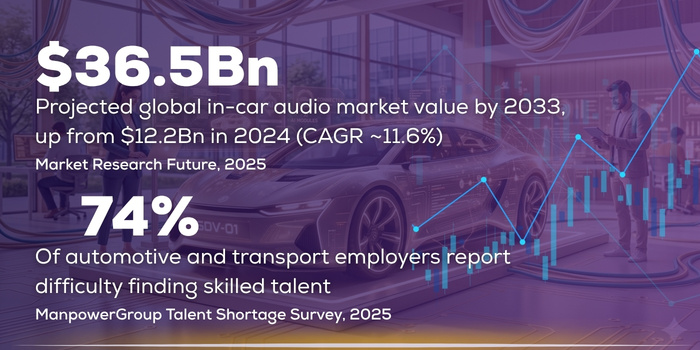
The global in-car audio system market was valued at approximately $12.2 billion in 2024 and is projected to reach $36.5 billion by 2033 (Source). This is a compound annual growth rate of over 11%. Behind every point of that growth curve is a product team making decisions about what to build, how to position it, and how to bring it to market (Source).
This is the context in which companies like HARMAN, Pioneer Electronics, Marelli, Forvia, and Qualcomm are competing. Each is navigating rapid technological change, shifting OEM expectations, and a talent market that simply cannot keep pace with demand. In this environment, the strength of your product team and your ability to build it is a genuine competitive advantage.
The Automotive Audio Sector: What’s Driving Change
Several forces are reshaping how automotive audio companies think about products, people, and strategy:
1. The Software-Defined Vehicle Revolution
Vehicles are increasingly software platforms first, hardware second. Audio systems are no longer isolated components; they are deeply integrated into digital cockpit architectures, connected to AI assistants, and updated over-the-air. This changes everything about what a product team needs to know and deliver.
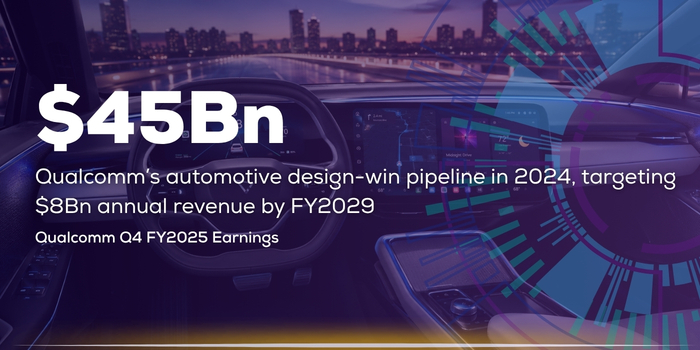
Qualcomm’s Snapdragon Digital Chassis platform is one of the clearest illustrations of this shift. Qualcomm’s automotive revenues surpassed the $1 billion quarterly milestone in Q4 FY2025, up 17% year-on-year, with a total design-win pipeline of $45 billion. The company is targeting $8 billion in automotive revenue by FY2029, a number that reflects the enormous commercial opportunity created as vehicles become rolling compute platforms.
2. Electric Vehicles Are Rewriting the Audio Brief
In a combustion-engined vehicle, engine noise masks many acoustic imperfections. In an EV, the cabin is near-silent, making premium audio both more important and more technically demanding. Automakers are now actively working with audio brands to create bespoke sound signatures, and active noise cancellation technology is becoming a standard rather than a premium feature.
Harman International, a Samsung subsidiary and arguably the most established name in automotive audio, won the award for “Supplier of the Year 2025” by General Motors. Under its new CEO, Christian Sobottka, formerly President of the Automotive Division, HARMAN is deliberately shifting towards a more product- and software-centric model (Source). Total group revenues reached $11 billion under outgoing CEO Michael Mauser, with a record $45 billion backlog in awarded automotive business.
3. Voice, AI, and the Connected Cockpit
Voice-recognised audio systems are forecast to hold a 62% market share by 2026, growing at an 11% CAGR. AI-powered sound enhancement, spatial audio, and personalised acoustic zones are moving from concept to production. The companies that can bring these features to market on time, at cost, with strong OEM partnerships are those with the right people in the right product roles.
4. A Market With Structural Talent Problems
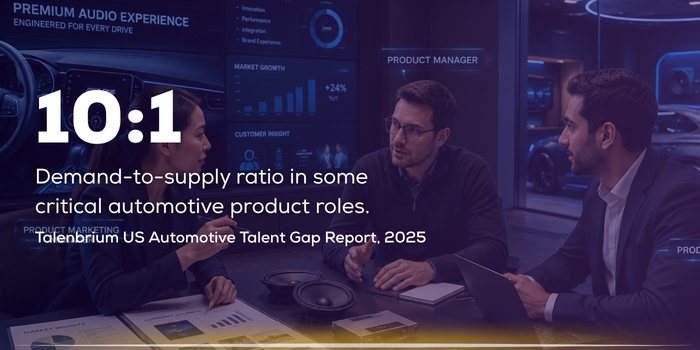
The skills gap in automotive is well-documented and getting worse. The UK automotive sector currently has 20,000 unfilled roles across more than 200 job categories, making it the second most talent-deficient sector in the country (Source). Globally, the industry is projected to face a shortage of 2.3 million skilled workers by 2025, rising to 4.3 million by 2030. In some critical product and engineering roles, the demand-to-supply ratio has reached 10:1.

Product Teams: The Engine Behind Automotive Audio Strategy
In the automotive audio space, a product team is far more than a group managing a spec sheet. These teams sit at the intersection of technology, commercial strategy, OEM relationships, and consumer insight. They are responsible for translating market opportunity into a product roadmap, and that roadmap into revenue.
What a High-Performing Product Team Looks Like
Across the major players in this space, the characteristics of high-performing product teams are consistent:
- Clear product vision aligned with business strategy
- Teams that understand where the market is going, not just where it is
- Ability to connect product decisions to P&L outcomes
- Deep domain expertise
- Knowledge of automotive audio hardware, software, and OEM integration requirements
- Familiarity with the homologation process, platform lifecycles, and supplier dynamics
- Cross-functional leadership
- The ability to work with engineering, sales, marketing, and C-suite stakeholders simultaneously
- Strong communicators who can translate technical complexity into commercial language
- Commercial accountability
- Ownership of pricing strategy, go-to-market plans, and competitive positioning
- An ability to manage the tension between innovation investment and near-term revenue targets
- Commitment to core values
- Innovation, integrity, teamwork, excellence, inclusion, respect, and ingenuity are not just aspirational words for companies like HARMAN, Pioneer, and Forvia, they are the operational standards by which product decisions are made and talent is evaluated
Values-Led Hiring: Not a Nice-to-Have
The five companies at the forefront of automotive audio – HARMAN, Pioneer Electronics, Marelli, Forvia, and Qualcomm – each reflect the importance of product team strength in distinct but complementary ways.
HARMAN International
HARMAN’s strategic pivot under its new leadership is instructive. The shift from a hardware-led to a software- and product-centric business model is not something that happens by decree – it requires product managers, product marketers, and sales leaders who understand both the technology and the commercial levers. HARMAN’s core values emphasise innovation and excellence, and those values need to be embodied at the product team level to have any practical meaning.
With more than 50 million automobiles on the road equipped with HARMAN audio and connected car systems, the scale of product responsibility is enormous. Product decisions made today will be heard in vehicles for a decade.
Pioneer Electronics
Pioneer has evolved from a consumer audio brand into a significant player in automotive infotainment and navigation. The company’s ability to pivot its product offering in response to OEM demands, including voice-controlled tuning systems now featured in approximately 47% of its product lines, reflects a product team culture that values agility and ingenuity.
Marelli
Marelli’s talent-led growth story is particularly striking. In India alone, its Technical Centres expanded from 300 engineers in 2022 to nearly 1,000 by 2025, a threefold increase in three years. The company’s hiring philosophy prioritises capability and hands-on domain expertise over conventional credentials, a model that is increasingly recognised as essential in fast-moving technology environments.
Marelli’s stated mission is “to transform the future of mobility through working with customers and partners to create a safer, greener and better-connected world.” This requires product teams who can operate across the full value chain, from concept through commercialisation (Source).
Forvia
Forvia, formed from the merger of Faurecia and HELLA in 2022, now covers seating, interiors, lighting, electronics, clean mobility technology, and lifecycle solutions. Its digital and sustainable cockpit experience portfolio places it firmly in the automotive audio and in-cabin environment space. Forvia’s emphasis on sustainability and innovation is embedded in its hiring commitments, including specific programmes around gender diversity and early-career development.
Qualcomm
Qualcomm’s role in automotive audio is perhaps the most structurally significant. Its Snapdragon Digital Chassis platform is the compute and connectivity backbone on which many OEM audio and infotainment systems now run. Qualcomm’s automotive design-win pipeline reached $45 billion in 2024, with $15 billion in ADAS-specific opportunities alone. The product teams responsible for that pipeline are not just managing a chipset; they are managing platform relationships with virtually every major automaker globally (Source).
Qualcomm’s values around innovation and integrity are reflected in its product roadmap discipline: revenue targets of $4 billion by FY2026 and $8 billion by FY2029 are not aspirations; they are product commitments that require exceptional people to deliver.
Values-Led Hiring: Not a Nice-to-Have
Across HARMAN, Pioneer, Marelli, Forvia, and Qualcomm, a consistent set of values appears in public hiring commitments and strategic documents: innovation, integrity, excellence, inclusion, respect, teamwork, and ingenuity. These are not decorative. In automotive audio, they map directly to the operational behaviours that determine whether a product team succeeds or fails:
- Innovation: The willingness to build new things, not just iterate on existing ones. In a market moving this fast, product teams that lack a genuine innovation culture fall behind within product cycles.
- Integrity: Automotive products carry safety implications and long OEM relationships that depend on honest technical and commercial commitments. Product leaders who cut corners damage trust that takes years to rebuild.
- Excellence: OEMs hold suppliers to rigorous quality and delivery standards. Product teams that are not relentlessly focused on execution create downstream problems that reverberate through the supply chain.
- Inclusion and respect: diverse product teams make better decisions. This is not a platitude; it is supported by evidence across technology and manufacturing sectors. For audio products serving global vehicle lines, diverse perspectives improve outcomes.
- Teamwork and ingenuity: the complexity of modern automotive audio, spanning hardware, software, AI, connectivity, and OEM integration, cannot be navigated by individuals working in silos. Collaboration and creative problem-solving are the practical requirements of the job.
When hiring for product roles in this sector, values alignment is not secondary to technical skills it is the filter that determines whether a technically capable person will actually thrive and contribute in a complex, fast-moving, cross-functional environment.
The Critical Roles Driving Product Success
The following roles sit at the heart of product team performance in automotive audio. Each requires a specific blend of domain knowledge, commercial awareness, and leadership capability that makes them genuinely difficult to fill:
Product Management
Product Managers in automotive audio are responsible for defining what gets built and why. They manage roadmaps, prioritise features against OEM requirements, navigate platform lifecycles, and hold technical and commercial accountability simultaneously. The best product managers in this space combine software fluency with an understanding of the automotive supply chain and OEM qualification processes. A combination that is genuinely rare.
Product Marketing Management
Product Marketing Managers translate product capabilities into commercial propositions. In automotive audio, this means understanding the OEM customer, the end consumer, and the competitive landscape well enough to position products compellingly across all three. With the market moving toward AI audio, spatial sound, and software-defined systems, the ability to articulate differentiation in a technically credible way is becoming a premium skill.
Product Sales
Product Sales professionals in this sector sell technically complex, long-lead-time solutions to sophisticated OEM customers. The sales cycle can run years, and relationships are built on deep technical understanding as much as commercial acumen. Candidates need sector-specific networks and the confidence to engage with engineering, procurement, and executive stakeholders simultaneously.
Product Leadership
At the VP, Director, and Head of Product level, the requirement is to build and lead teams that can deliver on all of the above at scale. Strong leaders in this space combine strategic vision with operational discipline – they know how to run a global product function, how to manage OEM partnerships at an executive level, and how to create the culture in which their teams can do their best work.
The shortage of candidates who genuinely combine all of these capabilities with automotive audio sector experience is one of the defining talent challenges of this moment. In some roles, demand-to-supply ratios have reached 10:1. This means that for every ten open positions, there is roughly one truly qualified candidate in the market (Source).
Why Specialist Recruitment Is the Answer
Given the combination of a fast-growing market, a specific set of in-demand roles, and a structurally constrained talent pool, generalist recruitment simply does not work at the level these companies need.
The 2025 ManpowerGroup Talent Shortage Survey found that 74% of automotive and transport employers are struggling to find skilled talent. Only 36% of hiring targets in the broader manufacturing sector were met in 2024. These numbers reflect a fundamental mismatch between what companies need and what a standard recruitment process can access (Source).
Specialist recruitment in automotive audio works differently. Here is why it matters across each of the critical role categories:
Access to Passive Talent
The most capable product managers, product marketing managers, and senior sales leaders in this sector are not applying to job boards. They are employed, often at direct competitors, and need to be identified and approached with a compelling reason to consider a move. This requires a recruiter who knows the sector, knows the candidates, and has the credibility to have that conversation.
Domain Credibility
Candidates at VP and Director level will not engage with a recruiter who cannot speak intelligently about the role, the company, or the competitive landscape. Specialist recruiters in automotive audio can articulate the difference between a cockpit domain controller role and a telematics platform role, and can assess whether a candidate’s experience is genuinely relevant, not just superficially similar.
Values and Culture Fit
Placing a highly capable person in the wrong cultural environment is a cost to both the candidate and the business. Specialist recruiters who work consistently within a sector develop an understanding of how different companies actually operate — beyond what the careers page says — and can match not just skills but working styles, leadership approaches, and cultural fit to the values that companies like HARMAN, Marelli, Forvia, Pioneer, and Qualcomm genuinely hold.
Speed and Precision
In a market where the demand-to-supply ratio for key roles can reach 10:1, the speed and precision of a hire matters commercially. A Product Manager role that sits open for six months is a product roadmap decision that does not get made, a customer relationship that does not get managed, and a revenue target that does not get met. Specialist recruiters reduce time-to-hire by bringing pre-qualified, relationship-mapped talent to clients faster than any internal team can replicate.
Long-Term Partnership
Building a product team is not a one-off exercise. As product lines evolve, as OEM relationships deepen, and as companies pivot to software-defined platforms, the talent requirement changes too. A specialist recruitment partner who understands the business and the market can support workforce planning at a strategic level, not just fill the next vacancy.

The Right People, in the Right Roles, at the Right Time
The automotive audio market is entering one of its most consequential periods of growth. The convergence of software-defined vehicles, AI-powered audio, EV adoption, and OEM partnership dynamics has created both enormous opportunity and genuine complexity for the companies at the centre of it.
HARMAN, Pioneer Electronics, Marelli, Forvia, and Qualcomm are all navigating this landscape with ambition and scale. Their ability to execute on that ambition depends, more than any other factor, on the quality of the product teams they build. And building those teams with the right values, domain expertise, and commercial capability requires a recruitment approach that matches the sophistication of the challenge.
Specialist recruitment is not a premium on top of standard hiring. In a sector this specialised, with talent this scarce, it is simply the most reliable way to get the right person into the room.
If you’re building a product team in automotive audio or looking for your next move within one, we’d welcome the conversation.